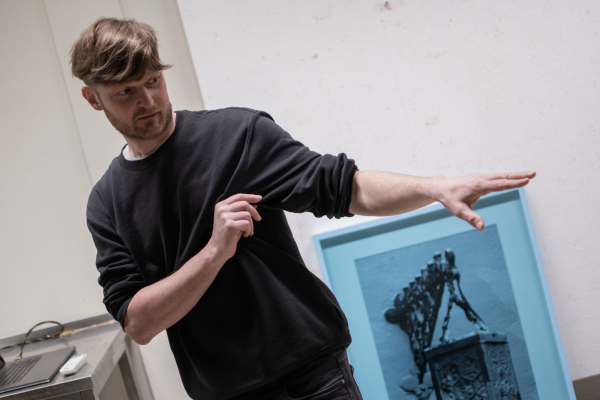
Lukáš Machalický (* 1984) graduated from the UMPRUM in Prague (2003-2009). In 2008 he completed an internship in Berlin (UdK) and between 2012 and 2014 he lectured at Charles University. In 2011 he co-founded the SPZ Gallery, which he has been running since 2024 with Mark Ther. From 2016 to 2023 he was first assistant, then head teacher at the Painting 1 studio at the Academy of Fine Arts in Prague. Machalický is the co-author of the publication "Are You Getting Ahead When You're in Line?" and "Knock Knock". He has completed artist residencies in New York (ISCP), Krakow (Imago Mundi), Bratislava (SPACE) and Florence (FUA). He regularly exhibits in the Czech Republic and abroad. He is the author of the architectural design of a number of exhibitions.
This interview with the artist was conducted on the occasion of his residency at the Telegraph, which concluded with Open Studio.
Years ago you published a book of interviews with artists, "Do you get ahead of yourself when you're in line?". What's it like to sit on the other side and answer questions now?
It's been so long I hardly remember. Answering is more natural. Back then it was connected to the artists who exhibited at the License Plate Gallery, it was such a cross section. We asked the questions in pairs, the catalogue edition was rounded off with an exhibition where we inserted a fictitious trafika into the gallery, we then incorporated the whole run into the print offer. I guess it was faithful, because occasionally someone would come in to buy a public transport ticket. I saw it more as an exhibition. The questions were often informal, we tried to divert attention away from questions like what are you working on at the moment. But we also asked stupid questions like "Ai Wei Wei, or Huawei?" and "David or Black?" This was based on lifestyle magazines like Vogue or Elle, which have similar sections.
Moving to the Telegraph for a residency means a change of studio and daily routine for you. How does this change of scenery affect the way you think about your work and what it means for you to create outside of your Prague background?
I went to the Telegraph with a clear plan. I was finishing up a few things for an exhibition at GASK, that was a given. But it's also the nature of my work that you can't do without planning. It's a kind of guided intuition. I've also had to juggle it with my family, the last time I was in residence was ten years ago, now we're in a slightly different situation, someone has to walk the dog and take my daughter to school. But I'm one of those people where an experience like that is more likely to be written in hindsight.
I'm interested in your general relationship with the show space. When you walk into a new gallery, what is the first thing that catches your eye?
Completely ordinary things like the type of flooring, the lighting, whether it's noodle or cube... I quickly see if there's something I can do. But generally the spaces where there's a problem are more interesting.
You work with space in a very specific way. You combine architecture, graphic design and free art in your work. What does this intermingling of disciplines and disparate materials allow you to communicate?
It allows for a complex message, because I often see an exhibition as one work that the viewer goes through. They're looking at it from a slightly different perspective than when they're standing in front of it. It also allows me to escalate the perception of the whole through the various sub-elements that make it up. I try to make the individual works stand as such, but the multiplication has an exponential curve.
Speaking of materials, you usually work with utilitarian objects in your installations, whether they are mass-produced items or straight gallery furnishings like display cases and plinths. In your work they lose their original function and become pure form. How does your initial encounter with the material actually take place? Are you looking for a specific object for a concept you've already thought of, or are you inspired by the found object itself?
It seems like that, but they are almost never taken objects, on the contrary everything is quite laboriously made to measure. It's a kind of abstracted reality. For the exhibition Who is the Lord of the Váh and the Tatras at the GAF in Žilina (with Lukáš Jasanský/Martin Polák) I made 6 m high, half-turned panels that bridged the ground floor and first floor... It became more like glacial blocks and then the rest of the exhibition unfolded from there. A platform was acquired for the exhibition and viewers could move between the pieces.
The result of this work with the material is installations that often look very considered and geometrically clean. What is the actual creative process like for you before you get to that final point?
I mentioned the laboriousness, unfortunately it is inherent. It's not something I pick on, but it often slides down to that. I don't even think laboriousness is a guarantee of a good result. Most of the time, though, ease is hard to come by. I spend a lot of time on the computer before the actual implementation, I use 3d software like architects do, I'm consistent about it. It tells you a lot about scale, but it's also fairly easy to test how a motif works. Realization is then a matter of weeks, sometimes months, and involves a lot of manual work and testing.
Although your installations feel very precise and clean, you are deliberately introducing a moment of disruption or purposeful failure of a given order. Why are you interested in this particular imperfection?
Because it always is, things are more complicated. And I also feel like I'm a little obsessive about this. Sometimes it's good to throw up on a clean floor.
When you finish the whole installation and the show opens, you hand it over to the audience. Do you care about the audience accurately deciphering your original concept, even the moment of error, or are you more concerned that they take away a purely intuitive or spatial experience?
In principle I don't care, I'm not targeting a specific viewer. It's best if you can make something that's transferable to the average exhibition goer, and at the same time it carries additional layers that they don't necessarily need to understand. I don't consider an exact interpretation necessary, I think contemporary art can be entered without preparation.
Besides being an artist exhibiting in galleries, you run one yourself. In 2011 you founded the License Plate Gallery with Robert Šalanda, which you currently run with Mark Ther. Is it hard for you to separate in your head the role of a freelance artist from the role of a curator and organizer of other people's exhibitions?
Not at all, but that's because I don't consider myself a curator. It's different when the gallery is run by artists. We don't see things from such a distance as curators and we focus a lot on the visual aspect of the whole program. We want it to have a certain dynamism and we're happy to show almost contradictory artists in succession.
Your other role was pedagogical. You ran the painting studio at AVU for years, although your own stuff is more spatial and conceptual. What did that experience give you for your own practice?
Painting is a bit like mathematics, the queen of the sciences, as the teachers say. We had it built on a combination of painting and someone who works with space to architecture... there are certainly a few painters who can encompass this and it's remarkable. Victor Man comes to mind. Sometimes I felt that the discussion at the defense boiled down to painterly finesse while we missed the more fundamental flaws. Also, that painting is a mysterious intuitive process is not entirely true. The plan is an important part of the creation, and this is no different between the different media. These were things that I reminded the students of from time to time. On the other hand, it certainly made me relate more to color.
We know what your work looks like in the gallery and at the academy. But when you're not setting up a show and running a license plate, what does your day-to-day look like? Are you able to put art completely out of your mind for a while?
This kind of relates to what I wrote in relation to painting. There's a bit of a naive idea about art in general, the classic cliché of the flamboyant personality, but in reality it's a very focused job and certainly requires a fair amount of systematicity and consistency. But of course the day varies depending on what stage of the work I'm in at the time. In terms of things outside of that, we spend a lot of time in the mountains finishing up the woodwork. There's ski mountaineering involved, but also downhill skiing, which I've been doing since I was a kid. Those things have a meaning because they get into your head over time. For me, it came through in the Polaris show (with Tomas Predka), where we worked with artificial snow and wandering in fog. I'm watching contemporary film, it's actually set in that direction as well. I've seen just about every stupid thing where there's snow.
What are your plans for the future besides your current residency? Where can we see your work in the near future?
I'm preparing an exhibition in GASK with the working title "Half Board", it's a bit based on the incredible construction of Hotel Vanicek, which was built by the entrepreneur Vanicek in Na Hřebenkách street from two garages without permission. Any postmodern architect would be ashamed of himself.
And to conclude, to come back here to Olomouc, what is the main outcome of your stay here? What specifically have you been working on in the Telegraph studio?
Right now it was a series of digitally manipulated lights that I'm rendering as a 3d model. It's a displaced reality that plays with eclectic lighting fixtures. Visually they give the impression of melting slightly... it's a thing on the border of fiction and reality. It's like the hotel that's out of this world.