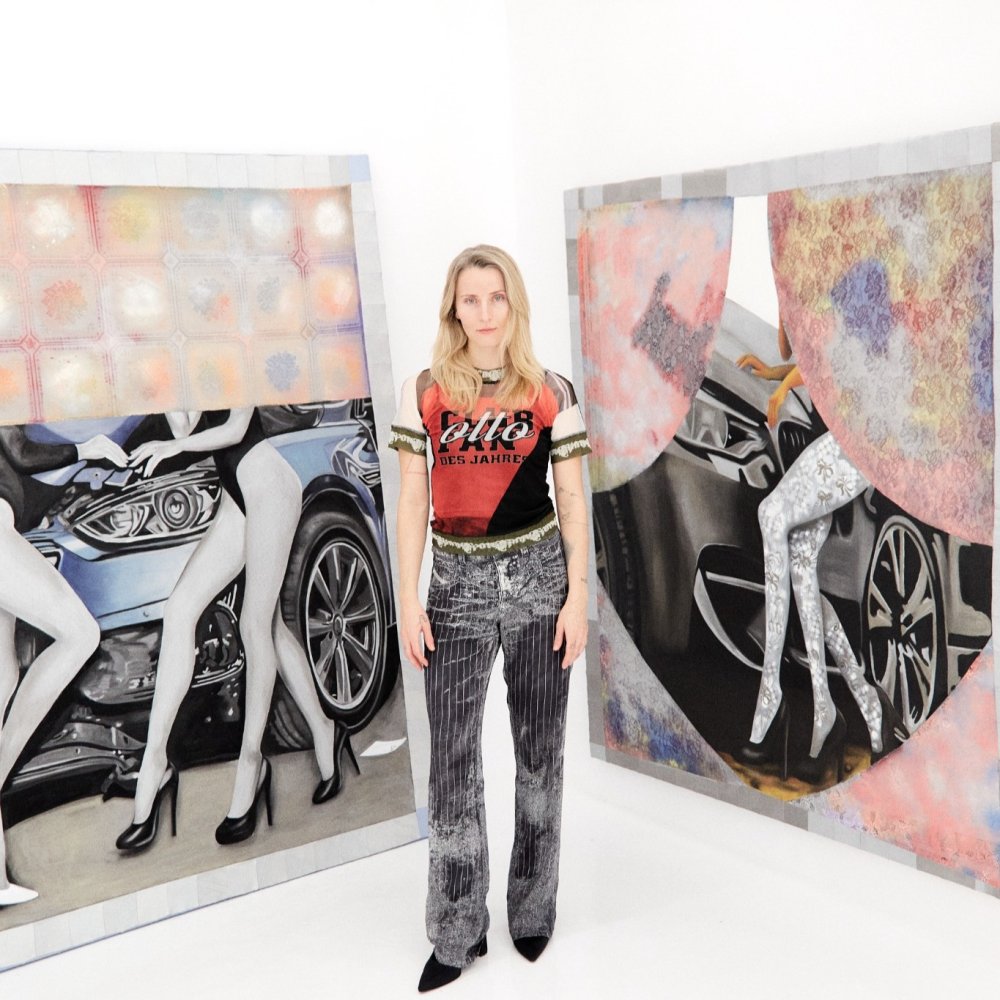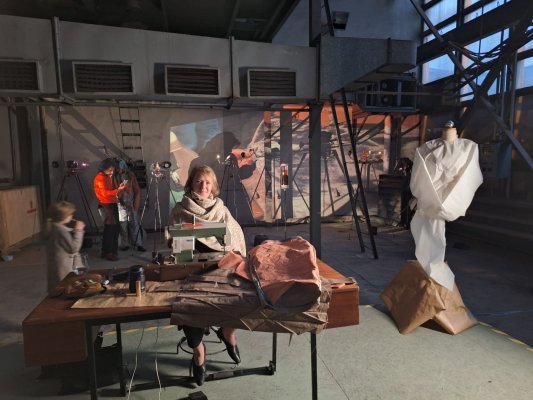
Barbora Kundračíková has long been active on the borderline between academic, institutional and independent artistic environments. She works as an assistant professor at the Department of Art History at Palacký University in Olomouc and at the Museum of Art Olomouc - Central European Forum (SEFO), where she headed the modern collections from 2019 to 2024. In addition, she works as a freelancer and collaborates with a number of galleries in the Czech Republic and abroad. Her practice focuses on 20th- and 21st-century art, questions of representation methodology, and the possibilities of interdisciplinary and inter-institutional collaboration.
At the Telegraph, she is currently developing Repeat After Me 2022, an intervention by the Lviv-based collective Open Group that turns the spotlight from images of war to sound. The project works with the acoustic trace of conflict - with the sounds of weapons, explosions or sirens that people carry as part of their own experience. Through the simple principle of 'repeat after me', it invites the audience to actively participate, turning the normally entertaining karaoke format into a tool for sharing trauma, memory and the experience of survival. Rather than spectacular display, it leads us to listen and become aware of our own role in engaging with the realities of war.
You are connected to academia, the museum and your own curatorial practice outside the institution. How has your journey evolved from working in a museum and department to a more prominent role as an independent curator?
I am a pro-institutional person - various institutions have been home to me since my student days. First MUNI and Morgal, then MUO, the Academy of Sciences and UP respectively. I am not an institutional type though. As I get older, I find that it may be better to discharge my need for invention or autonomy outside - and have peace at home. A Tuesday afternoon in the school office is a reward for me, much like the new exhibition in Lviv. But I must admit that my personal politics are not strategic; I just rarely say no to anything. I'm hungry and I have a lot of needs, and I really do love art absurdly, in all forms.
Was this journey more of a smooth broadening of scope for you, or also a conscious search for more freedom in what topics to open up and with whom to collaborate?
The state institutions I am most associated with have their own internal rules, a set of constraints and structurally set priorities. I took over the management of the MUO's modern collections in 2019, at a time when I was working in parallel at the CAS. Two years later, I accepted an offer to teach at UP. These institutions clearly defined my options and priorities. But now I'm only part-time at the museum, I've gotten used to the school environment and I'm finding it very convenient and interesting to combine these securities with freelance work, book projects and exhibitions. It's extremely varied, rewarding and fun. But of course it's also a bit of a trap - you feel like you can do anything, just to find the right channel. So you end up doing everything and everywhere, with successes fluctuating at times and freedom trivial.
When you're thinking about an exhibition, what's essential to you as a curator? What do you start with - a theme, a work, a space, or more of a question you need to ask yourself?
If I'm preparing a thematic exhibition, working on research and adapting that for an exhibition, then the main thing is him. It's also a concept that is often very abstract and complicated. As a student, and actually for a long time after school, I wasn't particularly attracted to working with live art. But in recent years it has been an absolute priority for me. Active artist, contemporary art, monographic projects. And in that case I am fully at their service, of course constructively and critically, in a transnational context. Not so long ago, I based all my texts on hype, on strong emotion, avoided describing the work and preferred to choose metaphors, to insert poetry, to question a lot - but actually I still do that... But I prefer transparency - it's the work that speaks, it's not me and it's not the artist. So I'm increasingly taking my own need for poetry elsewhere.
How did the idea of featuring the Open Group collective's Repeat After Me 2022 in the Telegraph come about? What was the first impulse and why did it make sense for you to introduce it to the Olomouc audience?
The Open Group projects are among the most interesting one can encounter in Central Eastern Europe. They are stimulating, attractive, engaging, but also sensitive and poetic in a special way. Yuriy Biley, Anton Varga and Pavlo Kovach (who, incidentally, is now active in the Ukrainian army on the Eastern Front) are also artists worth paying attention to in person. And then, of course, there is the key topic of contemporary politics - the functioning of the polis in the broad sense. I confess that my preference at first was the SOMA building, a former coal mine in the University Hospital, which is slowly becoming a space for experimental art. The second option was then the university's Konvikt. However, after installing the first edition of the 2022 project, which we presented as part of One World at Prague's Fotograf Zone, I came to the conclusion that Telegraph Pulse was exactly what I was looking for - it was installation-perfect, with good technological facilities, but most importantly, a bar in the foyer. As serious and sophisticated a work as it is, there is karaoke at its heart. And it was this paradoxical and as yet unexplored tension between (shared) entertainment and (personal) drama, this psychosis of the last hours before the end of the world, that excited me. And the gallery, but also Ecological Days Olomouc and the Polish Institute, to my amazement, came to my aid... Unbelievable!
Open Group has long been developing a collective and collaborative way of working and creating so-called "open situations". What do you find most important about their approach?
The fact that it is inherently horizontal and democratic, but at the same time does not renounce quality. Open Group projects target a discerning audience, but they do it smartly, knowing that every experience is structured. You have to be entertained, amazed, fascinated, disgusted, frightened to feel the need to think about or participate in the thing.
Personally, I'm more of an observer, I don't like educational activities, I can't easily relax in interaction. So I also appreciate the fact that no one forces me to do it here either, I can enjoy the work without actively entering into it - but when I do, it's even a bit better. And then there's the distinctive, yet minimalist, elegant aesthetic. It gives a sense of order even where we know there is none. To work in this way takes courage and self-control, and again, I value those highly. But it's not just Repeat After Me - I was even more struck by Open Group's previous work with Ukraine's largest airplane, the Mrya (translated as "Dream"), which they let fly, at least symbolically, over the grounds of the Venice exhibition docks before the Russians could massacre it.
The project works with sound as the primary vehicle of wartime experience. What do you think is its strength in mediating war not primarily through images but through hearing?
European culture is a culture of the eye. We understand the eye as an instrument of reason. We discern, identify, categorize, opine. The other senses don't have a similar burden, they are only "second". But they accentuate our emotions, fear, uncertainty, confusion... That's why the Open Group project is so interesting. Of course, the visuals are also important here - the hall, the projection and the position of the viewer, the respondent, is thought out in detail. You're stepping inside someone else's experience - and if everything works right, I didn't make a mistake during the installation, you can't get rid of this awareness. The image, the sound, and ultimately other sensory perceptions - the softness of the darkness calls for touch, certain words or sounds stir the nervous system, evoke smells, etc. - won't let you do that.
What do you think visitors should really watch or listen for in an exhibition? Is there a moment, detail or principle they shouldn't miss?
Most importantly, they should not approach the work, the respondents or each other reverently. We don't look at the victims, Open Group doesn't rehabilitate the victims. Their work gives space for specific people to find a voice, to take responsibility for their lives. If I were a regular attendee, I would have dinner, go to a screening, intervene, participate, have a drink, and then tell my friends and family about the shock it caused me.
When you look at the art of today, what do you find important to watch? Are there themes, approaches, or artistic positions that you think we should pay more attention to?
I think first of all we should learn to integrate better. I've been working for a long time with Central Eastern European art, with contemporary art, and both are finding their audience in complicated ways. This is true both for the presentation of new forms in the Czech Republic and Czech production abroad. It is time to introduce new categories, not only geographical ones, and to look for new ways of interaction. It is also time to redefine the relationship to the local scene.
Some time ago I had the opportunity to observe the creation of a new project by Valérie Mannaerts - sheer joy. In general I am interested in material approaches, for example that of Monika Pascoe Mikyšková or Mirka Klesalová, but also in the potential openness of new technologies, here I will mention the work of the Slovenian labs Kibla and Kersnikova, the Nurt collective or finally Open Group, Jiří Suchánek and Svitava Lab. I admire the resilience and richness of the individual imagination of the Kharkivans Kosti Zorkin and Pavlo Makov, I welcome the natural cosmopolitanism of contemporary new painting, but also the ever attentive eye of Wilhelm Sasnal, the latent political resistance of both Adams Albert and Kokesch... I feed on art, literally feed on it, and what I value most is the possibility to move across scenes, to combine, to accumulate, to experiment. I think that there are enough opportunities, despite the state of domestic and global politics, so I would welcome - and I apologize for not being more specific and "pure" - more optimism and ambition. Let us take things personally and take risks.
Is there anything you return to repeatedly in your current curatorial or research work?
I am just returning from a semester-long excursion to Ghent, where we participated in the traditional De Schone Week with art history students, this time led by Logomotion, Jeremiah Day and Wouter Davidts, and with the theme "Monument to Art: Radical Engagement". This is my main theme, personally, but also in general. And it was great to find out that I'm not alone, that there are at least ten great people in the Department of Art History who went into this with me without knowing exactly what was in store for them. Beyond that said, then, radical engagement.
What are you currently working on in addition to this exhibition? What topics or projects are keeping you busy right now? And are there projects ahead of you this year that you're particularly looking forward to?
Do you remember the Jim Carrey movie Yes Man? There are many, and on some level I refuse to choose. On my desk are books on Theodor Pištěk, Josef Klimeš, Jakub Roztočil, Zdeněk Trsa, new media, border-crossing by 20th century Central European women artists, and unexpectedly, the last Olomouc Thirties... Mykhaylo Barabash's exhibition in Lviv starts in April, Monika Pascoe Mikyšková's in Trnava in June, and Suchánek's in Maribor in June. I am hoping for Wilhelm Sasnal's first exhibition in Prague, a show of Czech art at the MAC VAL in Paris, and at the same time, together with Anna Olszewska, we are preparing another edition of RE:Senster: Labu in Krakow. There is the Open EDO of the Ecological Days Olomouc, SOMA with Petr Válek, the semester is still running, more discussions on contemporary art are waiting for us and the start of the sharp preparation of the first Olomouc "art week". The concept of the new permanent exhibition SEFO... Yes, Woman!