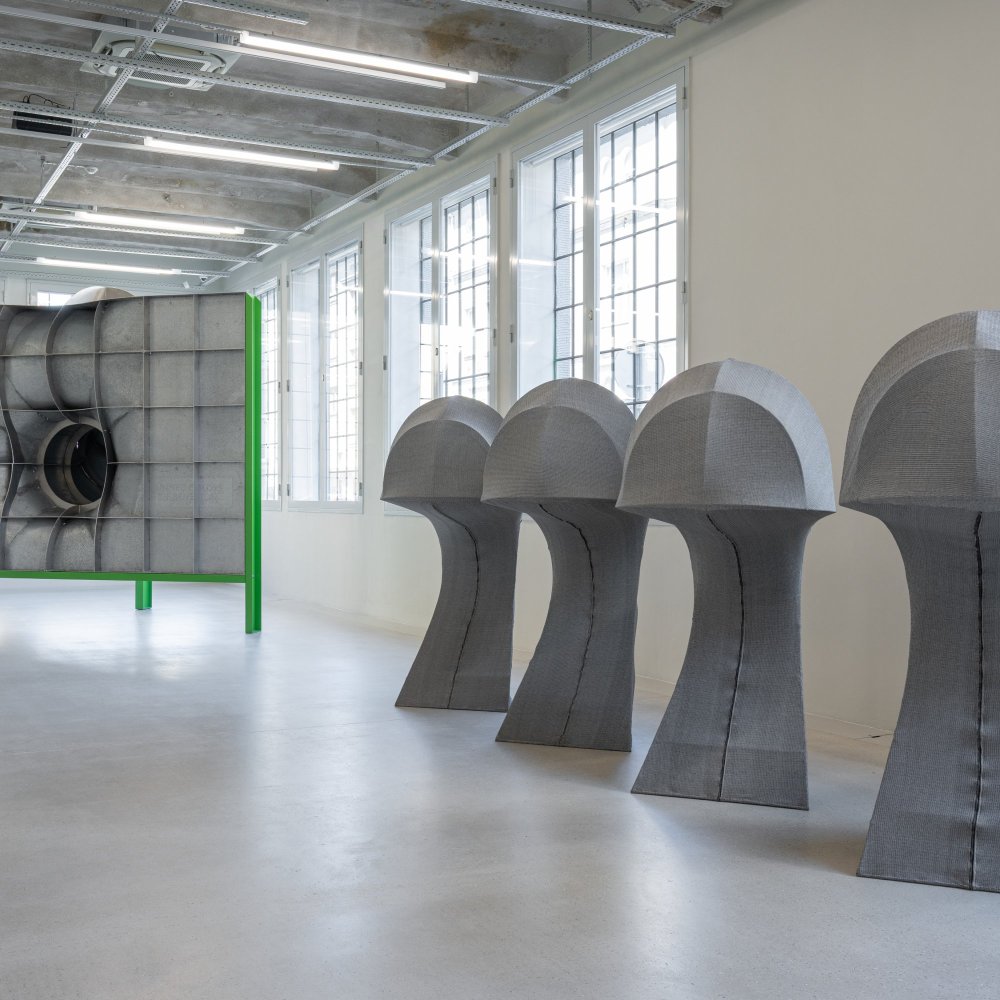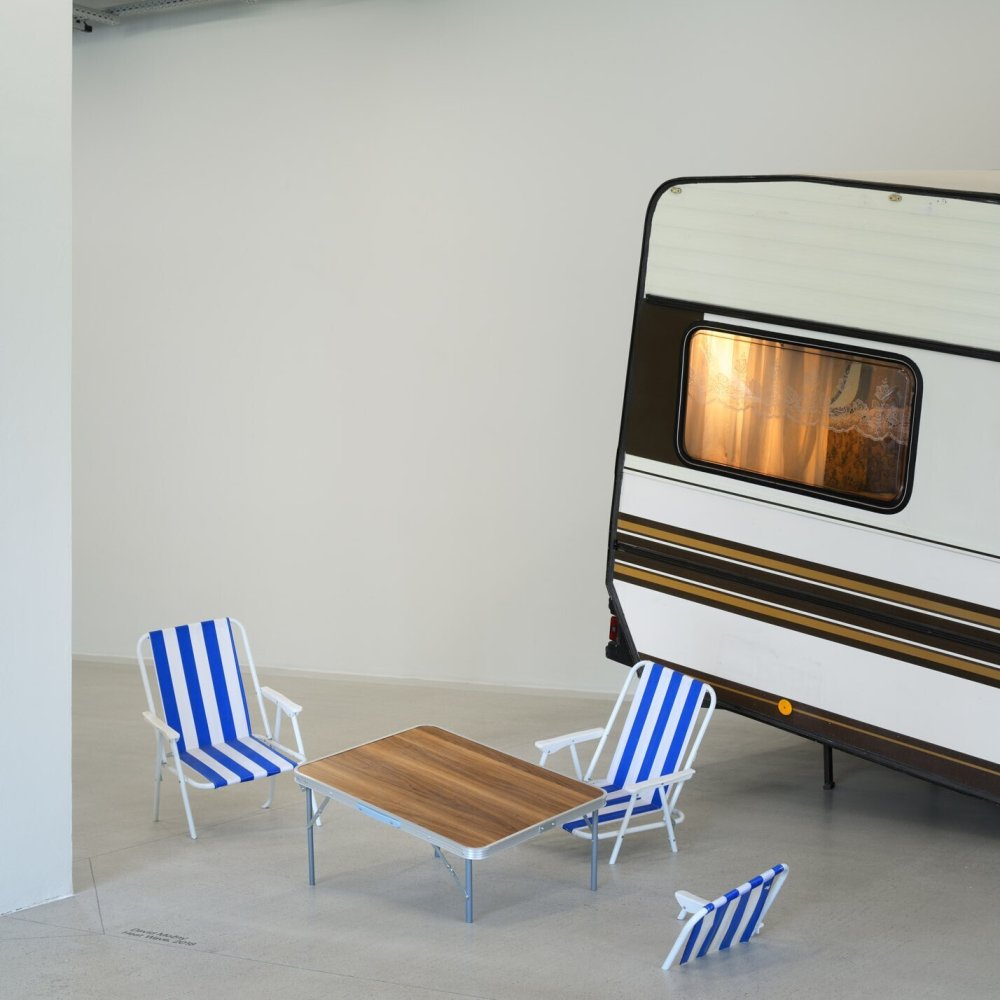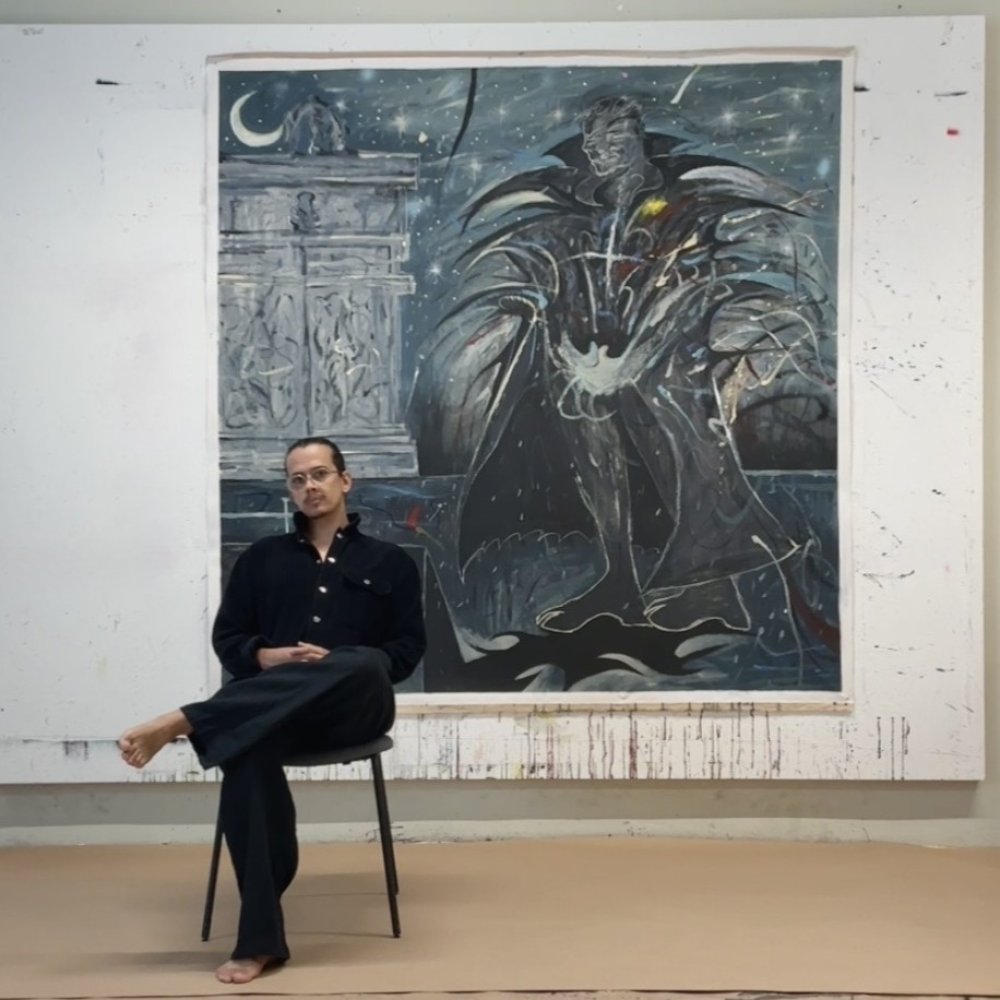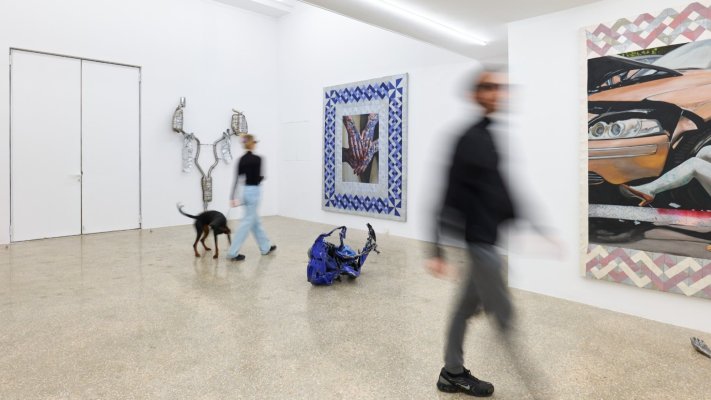
Alžběta Krňanská (*1992) is a Czech artist living between Prague and Athens. She graduated from the Academy of Arts, Architecture and Design in Prague (UMPRUM), and previously studied scenography, dramaturgy, and performance at DAMU. Her work combines painting, objects, installation, and work with textiles and metal. She is characterized by layering different materials and techniques, combining handcrafted techniques with digital technologies, and working with everyday objects.
In her works, she has long explored themes of gender roles, motherhood, safety, and the tension between private and public space. Her visual language also reflects her experience of living between the Czech Republic and Greece, as well as the environments of Prague and Athens. In 2019, she was a finalist for the Czech Art Critics' Award for Young Painters. She has exhibited both in the Czech Republic and abroad, and in 2023, she completed a residency at Telegraph, which concluded with an Open Studio and her participation in the exhibition Connection.
The last interview for Telegraph Journal was published in 2023. At that time, you were on residency at Telegraph and presented a series of automatic drawings as part of the exhibition Connection. For you, these represented a fast and spontaneous counterpart to technically demanding paintings. Do you still work this way?
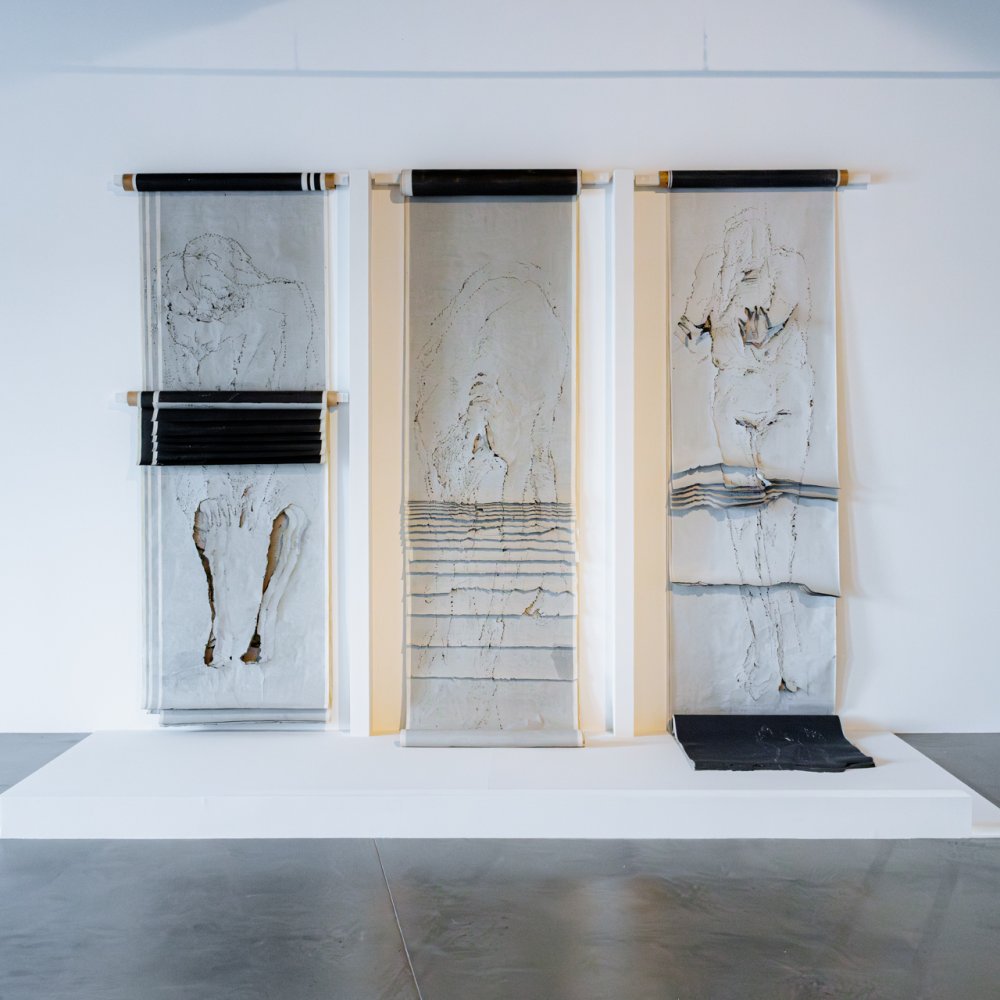
I still create automatic drawings. They often emerge while traveling, where conditions don't allow for more demanding production. I see them as a record of movement, time, and the space in which they come into being. At the same time, I perceive them as a way to mentally unwind from new impressions and information.
Back then, you talked about living between Prague and Athens. Today, you speak of Athens almost as a more permanent relocation. Do you manage to create in both cities?
Currently, I work mainly in Athens, where I have a permanent studio space. However, Prague remains very important to me, especially in terms of the contacts, opportunities, and relationships I’ve built there over the years. At the same time, I feel increasingly part of the international art scene, which is why I don't want to limit myself to a single scene or country. In my view, art has the power to cross borders, and the ability to move between different environments is crucial to me. I appreciate the distance that Athens affords me, as well as the possibility of returning to Prague.
Is it still true that the Greek scene strikes you as more open and optimistic, while the Czech scene feels a bit depressing?
I think that feeling still lingers to an extent, but today I wouldn't describe the two scenes so categorically. Living abroad has primarily given me distance, helping me notice things I used to take completely for granted back home. When you spend an extended period in a different environment, you begin to see your own biases and patterns of thought from a fresh perspective.
What I appreciate about Greece is a certain openness and spontaneity, and the local setting continues to inspire me deeply. At the same time, I don't believe one environment is inherently better than the other. Each carries its own constraints and advantages. To me, the most valuable aspect is the ability to navigate between different worlds while keeping a sense of perspective. It keeps me observant and curious.
In an interview for Galerie NoD regarding the exhibition Fatal Attraction, you mentioned that staying in Athens helped you react less to what happens to be "resonating" within a particular art scene, allowing you to trust your own intuition and experience more. Is it easier for you now to create work that doesn't necessarily engage with the immediate social debate?
Yes, definitely. I try to remain attuned to what is happening around me, but I feel no obligation to react to every current event. Living abroad helped me tremendously in this regard. I stepped back from a specific local scene and learned to trust my personal experience and what truly fascinates me. Art doesn't need to be an immediate journalistic dispatch. We aren't reporters tasked with detailing reality in real time. Yet, every work inevitably reflects the era and context from which it emerged, whether intentionally or not.
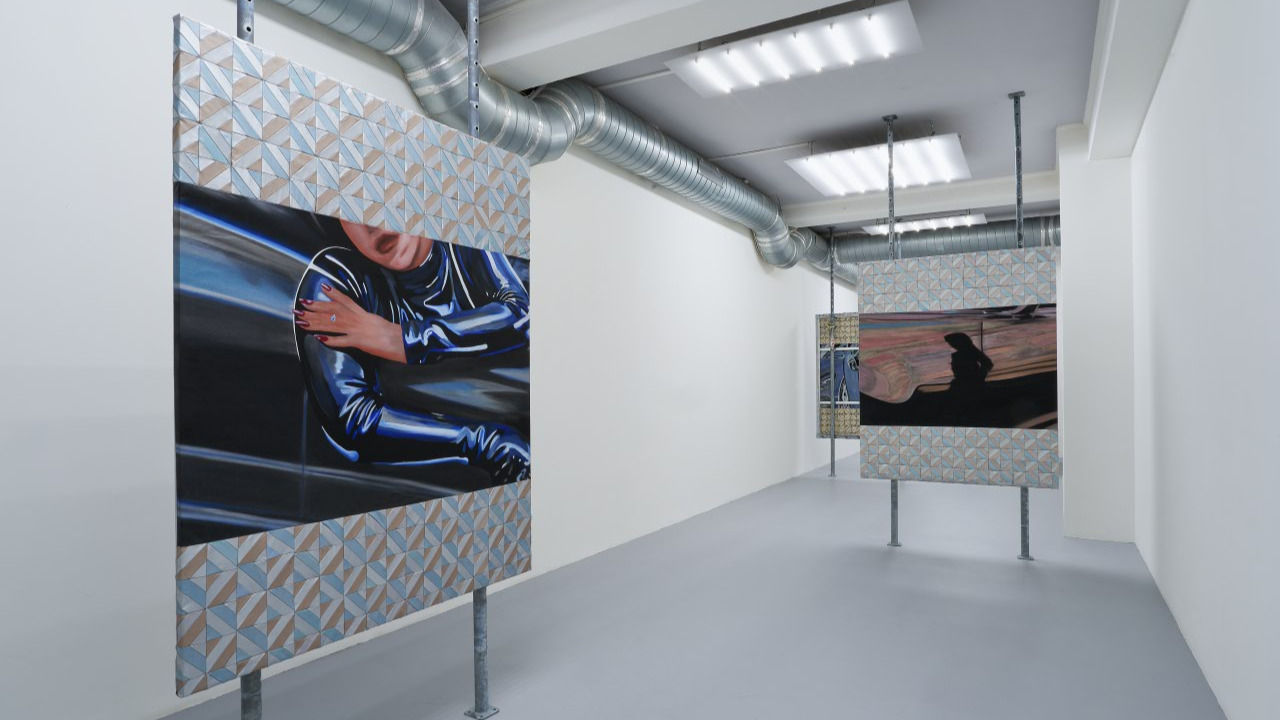
Cars have become a prominent motif in your recent work. You noted yourself that Athens shifted how you perceive them—ubiquitous, often battered, yet still operating as status symbols. Do you recall the moment you realized an automobile wasn't merely an ordinary everyday object, but could anchor an entire new series?
I think that realization crystallized when I drove an expensive luxury car for the first time. I became acutely aware of the power an automobile holds as a symbol of social status, and how deeply it influences not just how others perceive us, but our own behavior as well. What fascinates me is an object's capacity to acquire social value far exceeding its practical function. From there, the link to AI emerged naturally. I began questioning whether a technology supposedly capable of overcoming human bias and solving complex problems can truly present these tropes and stereotypes differently, or if it merely ends up reproducing them.
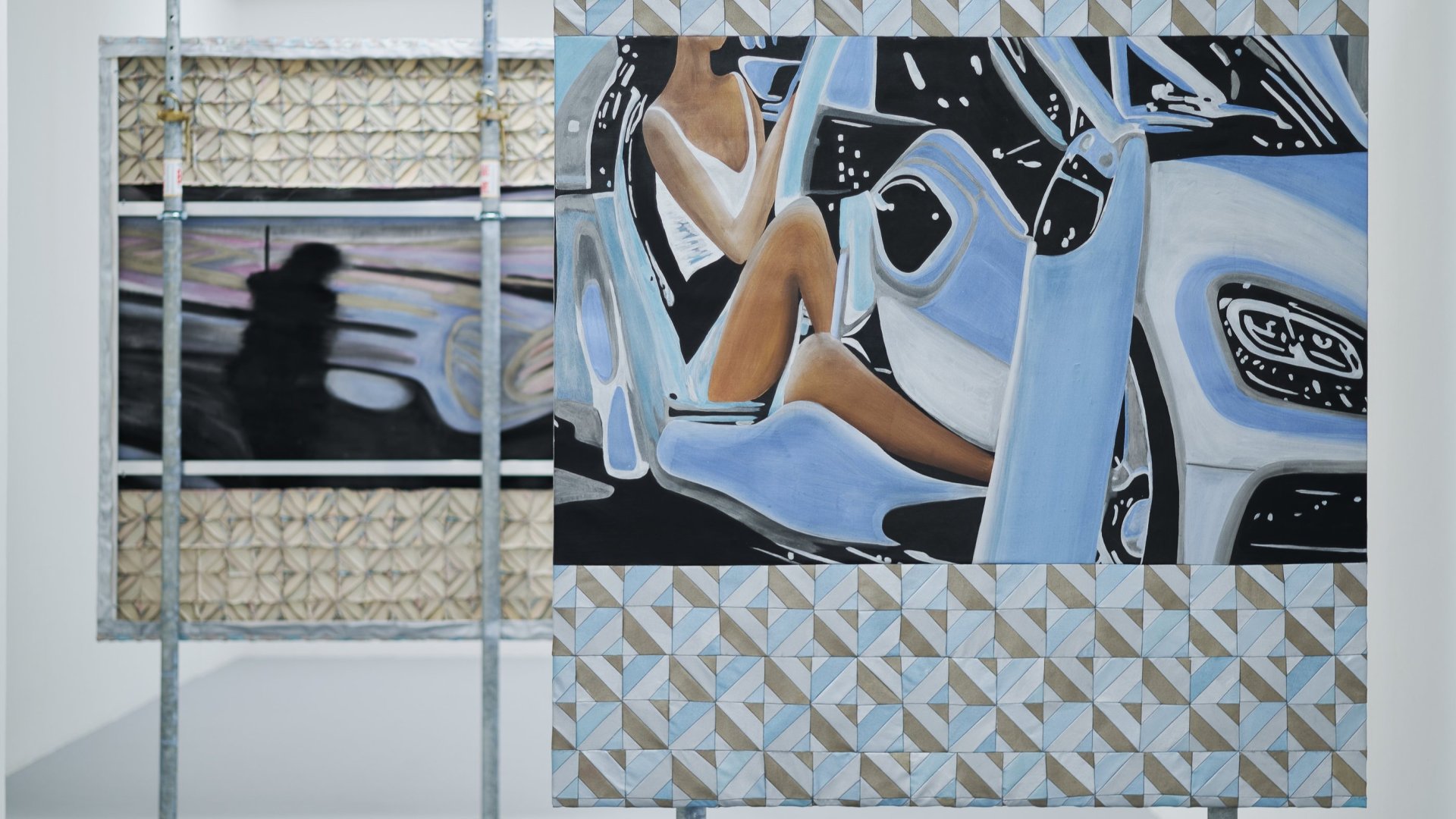
In the past, you mentioned an effort to reduce materials. Has that worked out, or have you found that the tension between different mediums—textiles, metal, print, painting—is something you simply don't want to abandon?
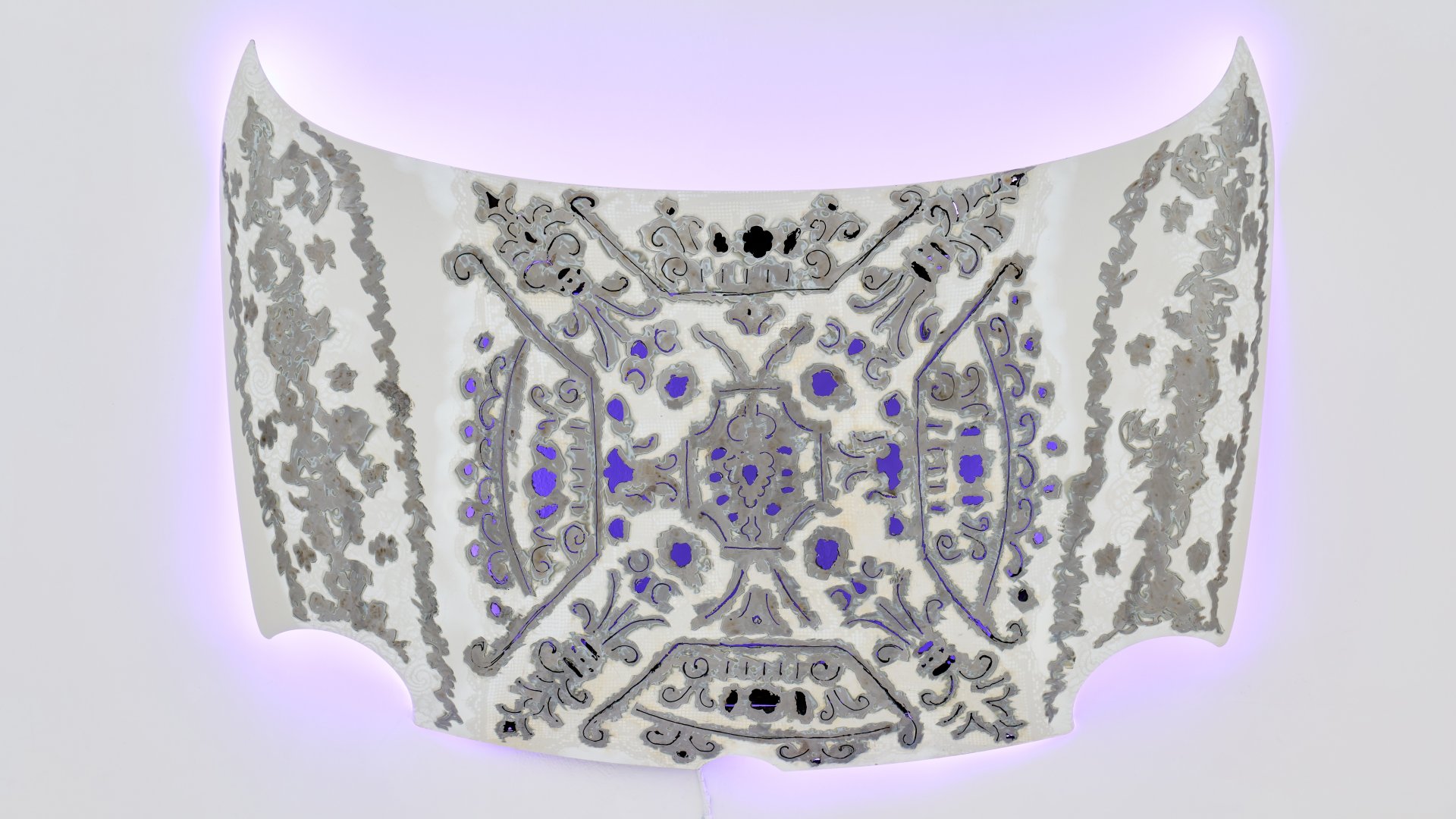
On the contrary, combining materials has proven fundamental to how I currently think. I enjoy using materials in ways that toy with the viewer's perception—through transparency, for instance, or as in my recent works, using iridescent pigments that make fabric appear like a metallic surface. Every material brings its own history, context, and associations.
At the same time, I enjoy using materials slightly against their expected function, giving them a new narrative or meaning. For example, painting onto crocheted doilies or cutting lace patterns directly into sheet-metal car hoods. I am intrigued by the moment when materials start contradicting one another or appropriating each other's inherent qualities.
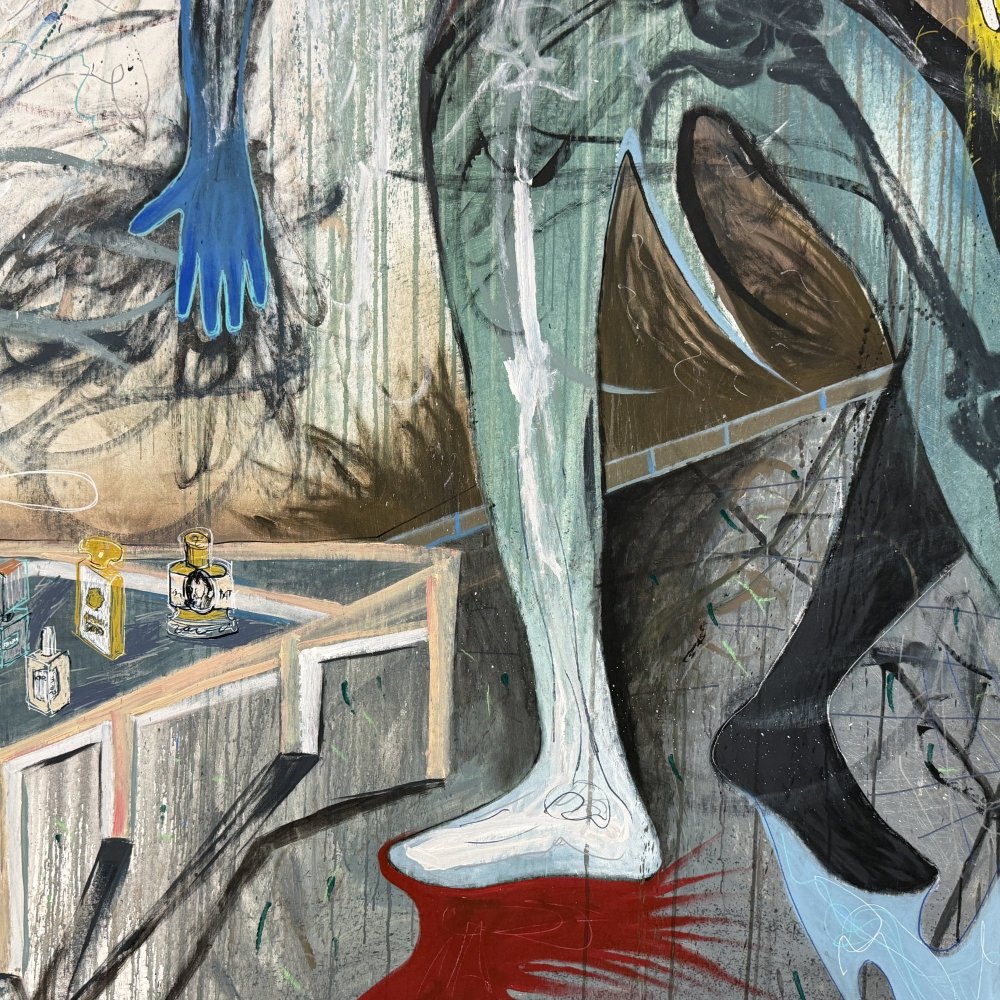
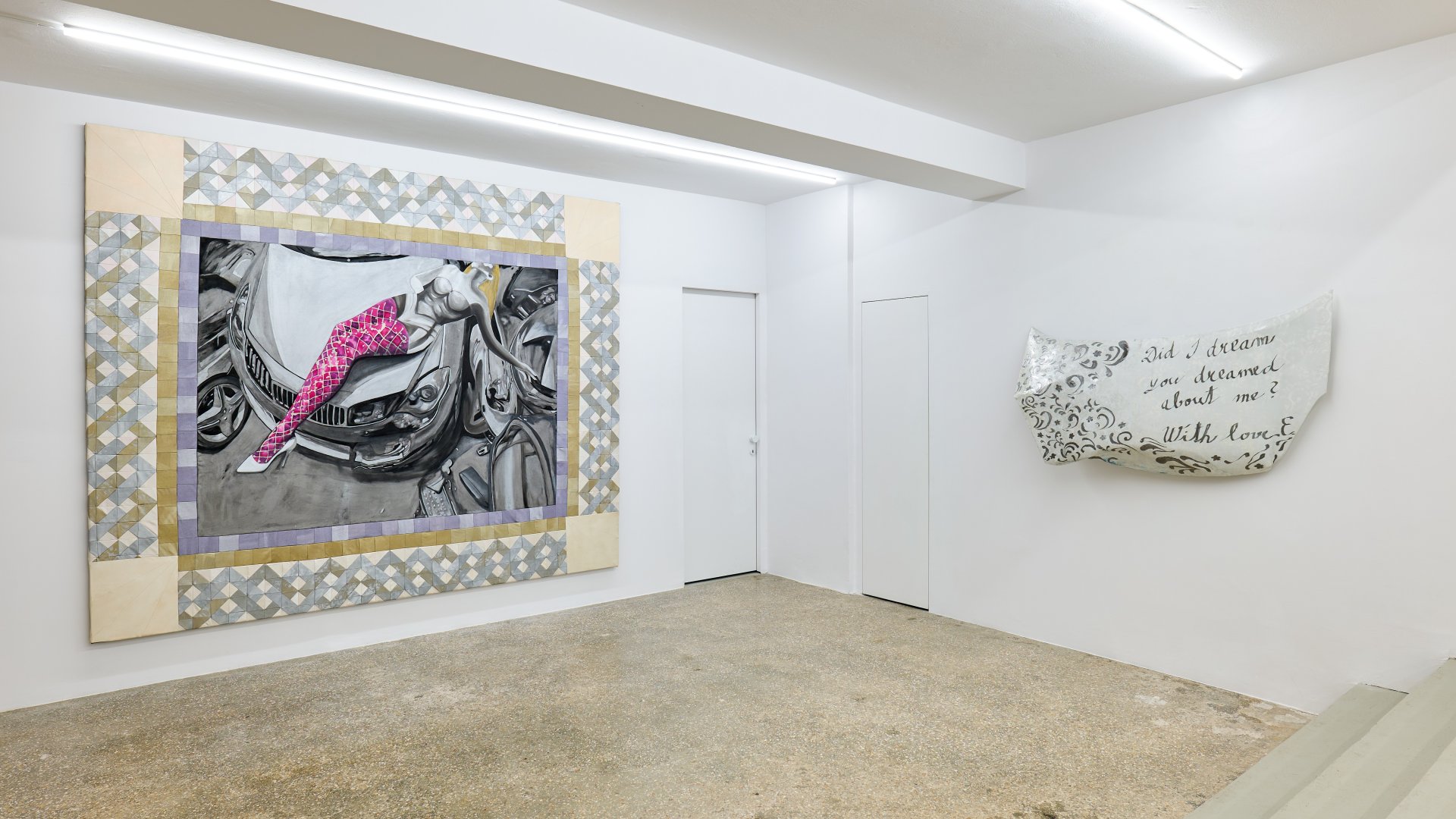
In your exhibitions CRUSH (2025) and Fatal Attraction (2026), which loosely build on each other, you link the female body with the car as an object of desire, power, and self-identification. You generate the female figures in your new paintings with AI. What happens when AI produces an image that is overly stereotypical or absurd?
That is precisely what draws me to AI. When I started experimenting with it, I was struck by how rapidly it generates depictions of women rooted in heavy clichés: the woman, the luxury car, high heels, a specific physique and posture. It quickly lays bare the visual tropes already entrenched in our culture.
When an image turns out excessively stereotypical or absurd, I don't feel compelled to fix it. I am drawn to the error itself—a warped body, an extra finger, or a subtle anomaly that suddenly makes the viewer uneasy. AI attempts to simulate the human figure, but these flaws expose just how little it truly understands us. Simultaneously, the technology is advancing at breakneck speed, and documenting this transitional, imperfect phase matters to me. It triggers an uncanny feeling—something familiar and alien all at once. It sits on that boundary between the natural and the quietly unsettling.
To me, these glitches are not merely technical flaws. They reveal how AI conceptualizes humanity and expose the existing images and cultural patterns it draws from.
How do you view working with AI now, considering the growing awareness of its environmental footprint?
It's definitely a reality I cannot dismiss. AI carries real costs and consequences, much like the technologies we rely on daily. At the same time, I remain intrigued by how these tools shape us—how they alter our attention, imagination, communication, and relationship to imagery.
However, I try to avoid feeling pressured to adopt an immediate, black-and-white stance on every new tool. The ecological impact is an inseparable piece of the conversation, and being conscious of it is vital. I'm especially fascinated by the paradox that this technology feels almost weightless and intangible, even though it is anchored by vast quantities of raw physical materials, energy, and infrastructure.
In 2025, you completed a two-month residency in Taiwan through the MeetFactory program. What did immersing yourself in such a completely distinct cultural and visual landscape offer you? Did any specific elements carry over into your current work?
Spending two months in a radically different cultural, technological, and visual landscape was profoundly meaningful. I was fascinated by the seamless integration of cutting-edge technology with craft, heritage, and routine daily life. My intention was never to bring home a single concrete visual motif. Far more impactful was witnessing how divergent cultural mindsets can coexist, and discovering alternative ways to relate to technology and tradition. That influence filters into my practice gradually. It reaffirmed my fascination with both advanced technologies and traditional craft, and with what unfolds when we place them alongside each other instead of treating them as opposites.
Looking back at your work since your residency at Telegraph, what has evolved most distinctly?
My handling of materials has probably undergone the greatest shift. I gradually stepped away from batik, turning instead toward intricate patchwork compositions and incorporating iridescent pigments that evoke the sheen of metal.
At the same time, I remain drawn to the friction between the softness of cloth and the rigid, industrial character of metal. Materials aren't just utilitarian vehicles to me; they carry their own history, associations, and contexts. Perhaps what changed isn't so much the way I produce work, but rather which elements I choose to place in tension and dialogue.
What lies ahead for you? Is a new series or project currently in progress?
Right now, I am developing an expansive project investigating emerging forms of intimacy between humans and artificial intelligence, exploring how our understanding of love and connection might shift in the coming years. I am interested in what unfolds when technology ceases to be a mere instrument and begins claiming space traditionally reserved for human relationships. I also have several presentations lined up for the autumn: at the Digital Art Festival in Taipei, alongside Delphian Gallery at Unit 1 Gallery in London, and at the Art Athina art fair.