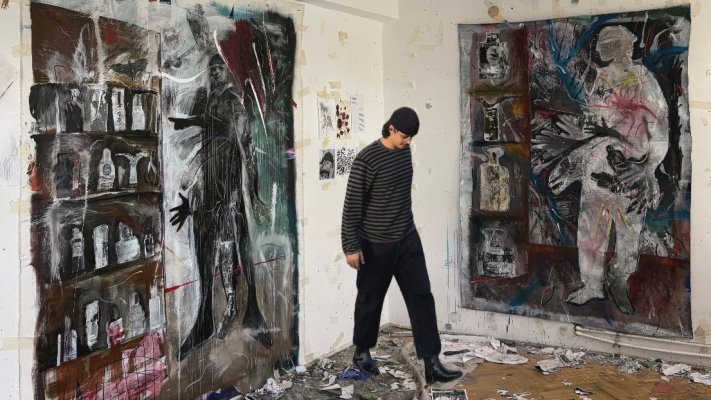
Laurentiu Zbircea (*2000) is a Romanian painter and representative of the Cluj School, whose previous generation has already firmly established itself in the field of European, and in some cases even world, painting over the last ten years. The artist's work is characterised by a surrealistic and neo-expressive character. His practice explores human senses as pathways to memory, identity, and introspection, with a particular focus on the sense of smell, which he considers fundamental to instinct, attraction, and life itself. Inspired by personal experience, emotions, relationships, the body, paradoxes, contemporary issues, and the idea of existence, his paintings examine the intersection of instinct and consciousness and their influence on human experience. Through painting and image-making, he transforms lived experiences into visual narratives in which the human figure often functions as an alter ego, exploring vulnerability, memory, and emotional tension.
The interview was conducted on the occasion of his residency at Telegraph, which will conclude with an Open Studio on 26 August 2026.
Your paintings are technically unconventional and composed of many layers. The viewer has to look at the paintings for a longer time and find additional layers and details of the painting to discover all the details. Do you plan these complex compositions in advance, or do they arise spontaneously during the painting?
Yes, my works are made up of many layers. This is something instinctive that happens when I paint. Sometimes the work is thought out beforehand. I have the concept, the idea, maybe even some colors in mind, but it is never completely intentional. Once I start painting, things come naturally and instinctively. It's almost as if I'm painting unconsciously, without fully realizing what I'm doing. Very often, these overlapping surfaces appear because, while I'm painting everything happens at the same time. I build the works almost like a collages.
So yes, it is intentional in a way, but also unintentional in another way.
Your work has been described as a personal confession that explores the Jungian collective unconscious - Jung's idea that all people share innate archetypal patterns that can manifest themselves in similar symbols, images and motifs. Where is the line for you between your purely personal memories and this deep, shared human unconscious?
At the core, I approach subjects, ideas, and feelings that we all experience. My interpretation may be much more personal because I often relate to these things as something personal to me. But in reality, they are not only personal. We all experience these things.
Your paintings feature characters that seem fantastical yet eerily familiar. For example, a traveller in a hat being chased by a shadow, or a man with a red tree growing from his heart. Do these characters and situations capture specific personal experiences from your life, or do they function more as general symbols?
I use a lot of symbols that are connected to the characters and figures I work with. I wouldn't necessarily take them too seriously. I mean, I don't think they should be taken too seriously, because they are there mainly to talk about my own experience, they are like a channel that allows us to connect with more personal experiences. The figure that feels more important is the dark figure, it represents a lot for me, he's the connection between unconscious and conscious, the alter ego. There isn't necessarily a repetitive pattern or a set of fixed things that I consider extremely important or that I never move away from. It always comes back to the idea of the symbol. Each character has something atypical about them, their own direction, their own identity, and their own story. But at the end of the day, among all these characters, everything goes back to me. They are all, self-portraits. I paint more about what I feel in those moments, and what I understand or know about what I am feeling.
You deliberately work with cultural clichés and symbols, such as pyramids, camels, or alien eyes from pop culture. Why do you enjoy taking these widely known symbols and mixing them with your own fantasy world?
I wouldn't say that the pyramids, the camels, or any other cultural subject or visual approach that appears in my work is particularly relevant as a long term symbol, not at all. They are simply inspirations that come and go. There are periods of time when I feel more inspired by certain subjects and feel the need to explore them. But there aren't necessarily certain subjects or visual elements that I keep coming back to because they represent something specific. These things are not that important to me. Each work is different. Each work has a different context, a different place, a different idea. The only real. The most important symbols that appear frequently in my work are: the dark figure, sperm cells (the idea of life and death), spheres and the self-portraits.
There is a strong contrast (dichotomy) in your technique. You combine graphic lines with wild, sensual colours. For you, is painting more about finding order through lines, or about freedom and chaos in colours?
For me, working, whether it's painting or drawing, is not about fixing things, and it's not necessarily about freeing myself either. It's simply a way of disconnecting, completely disconnecting. It's like a puzzle for me. I know I have to put certain pieces together, and I know what might come next, but at the same time, there is still a question mark throughout the whole process. So for me, the most important thing is simply to work and, let go, to lose myself. I don't like things that are too precise when it comes to details. I need to see in my work some sort of a calculated disaster, an harmony between simble and complex.
Your work combines influences from surrealism, neo-expressionism and primitivism. Yet your visual universe holds together tightly. How would you describe the main internal laws that govern your paintings?
I think what I do is a combination of everything, of all kinds of things. It's impossible to come up with something completely new. But when it comes to my work, everything is connected and held together simply by this instinct to work. Very often, I look at my works and think, okay, they seem very different from one another. And then there are periods when I look at them and think, okay, you can actually see that they come from the same place, the same universe, the same technique. I don't think there has ever been a concrete answer to this question. I don't know. Things just happen instinctively.
You belong to the youngest generation of the Cluj school, which is very well-respected in Europe. Do you feel any pressure or pride about it? How does this background influence your style?
I feel close to the Cluj School, and all I can say is that it motivates me. Seeing that it is possible motivates me even more. There's no pride and pressure involved.
You are now in Olomouc for a residency at the Telegraph. Does this change of environment – a different city, different light and a new studio – reflect in the works you are currently painting here? What does this time in Olomouc mean to you?
Honestly, the change of environment doesn't influence my work that much. It's not necessarily something that is relevant to my practice. This period here in Olomouc, during the residency at Telegraph , has been very productive for me because it allows me to work as much as I can, and that is very important to me. Right now, I'm in a very productive period, which makes me very happy and is extremely fulfilling for me as an artist. I really like it here, I'm happy to be here. It's a great opportunity, and I'm very grateful to be part of this residency. Overall the experience is absolutely great.