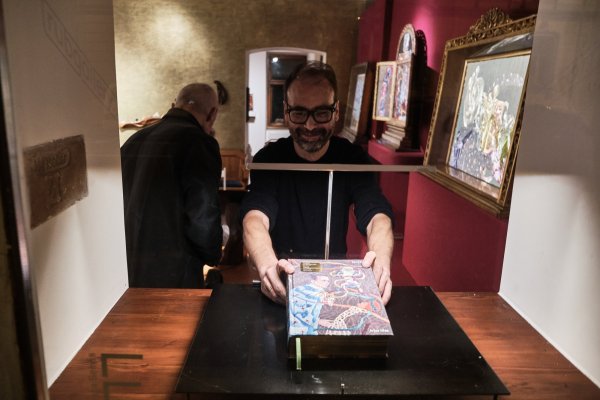
David Voda (*1976) is an art historian, curator, poet, collector and gallerist based in Olomouc. He studied art history at Palacký University and has long been dedicated to lesser-known chapters of Central European modernism and avant-garde, anthroposophical art, the Czech-German environment and other topics outside the mainstream of established art history. In addition to curatorial and research work, he is also engaged in poetry and publishing.
Since 2022, he has been running Rub Gallery in Olomouc, which combines his collecting, curatorial, research and publishing activities. He is associated with Telegraph Gallery primarily as the curator of the exhibition Signal III: Masterpieces from the Robert Runták Collection (1900–1990) from 2022. He also appeared at Telegraph in the TTalk format and as a guest at the screening of the documentary Hilma af Klint – Beyond the Boundary of the Visible , which was part of the Telegraph Film Festival 2022 program and continued his long-term interest in the relationship between spirituality, anthroposophy and modern art.
We met in 2022 at the Telegraph at the Signal III exhibition, which I consider one of the strongest projects that have been created here. At that time, you had in front of you Robert Runták's collection over a huge time span from 1900 to 1990. When you look at that exhibition four years later, is there anything that you would exhibit or interpret completely differently today?
Thank you, that's very kind. I'm glad that the exhibition still has an impact after all this time. It was created under a lucky star. Mark Thero's dreamy interiors were very inspiring and fundamentally influenced both my thinking and my choices. Coincidentally, I recently had in my hands the beautiful catalogue edited by Kuba Kovařík. Even after all these years, I wouldn't change a thing. On the contrary, I think it was timeless in a certain respect.
And perhaps a note, you say that I had works in front of me over a huge time span – first of all, it doesn't seem like a big time span to me, the history of art begins sometime around 40,000 BC, and secondly, that was exactly my intention. To look at the 20th century. At that horrible and fascinating century.
When a curator works with a private collection, they have to accept its limitations to some extent – they can’t just pick and choose from art history. Is this limitation ever productive for you? Can the absence of a particular work or artist steer the whole exhibition in a direction you wouldn’t otherwise go?
Of course. It's very limiting. But on the other hand, Mark Thero's "curtain-room" thinking helped. We simply hid something "behind the installation". We didn't quite manage to capture some -isms. Some works weren't quite masterpieces. And again, a note: you can't "simply choose anything" from art history. Unfortunately. As Jean Dubuffet says: "The history of art, as it is presented to us, is only the history of what suited the tastes of the social elites and snobs of a given era."
When someone introduces you, it's easy to start listing off the following: art historian, curator, collector, gallerist, publisher, poet – and for a long time also an industrial entrepreneur. Do you have one of these roles that you see as your core, or do you just need them to constantly alternate?
Good question. I have periods when I run wild. Germans say I dance at many weddings. Sometimes it's calmer. When I left my position as curator of the Olomouc Museum of Art in 2004, I thought my world had collapsed. But even though I was then working in the galvanic business, I still researched, wrote, organized exhibitions and started collecting furniture. I handed the company over to management 4 years ago and founded Rub Gallery. Looking back, however, I have always seen myself primarily as an art historian. That's all for me. Everything begins and ends there. Art history forever!
In a 2019 interview, you described your situation between art and running a galvanic shop as almost schizophrenic, saying that you dream of a “galvanic empire and a small gallery.” That small gallery actually exists today. It’s Rub Gallery, which you founded in 2022. Looking back on that dream from today’s perspective, does Rub match what you imagined back then?
To a large extent, it does, but it took time. But it also means that there is no such thing as a “galvanic empire”. I do discovery projects, often with a demanding book lately. I commute between topics that haunt me. And people come, they are loyal. That’s great. Of course, I wasted an awful lot of time and money on demanding installations, foreign loans, and much less on developing the brand with Jan Herynek, my visual designer, and on marketing. There is still room for improvement. However, it is also necessary to see that Olomouc is simply too small for some projects. I don’t mean that arrogantly. See, for example, the world exhibition of Mária Bartuszová at the Museum of Art. I saw her exhibition at the Tate Modern in London and it must be said that the Olomouc exhibition was much more elaborate, well-composed, and consistent. Actually, it was an absolute miracle.
Your collection and the Rub program do not seem like an attempt to encompass the “best” of Czech art. They are more like a very personal map of topics that have haunted you for a long time – anthroposophy, Czech-German art, Zlín, the avant-garde, literature. How do you recognize a topic that is worth following for ten or twenty years?
I'm more interested in how the subject will know that I'm the one, that it's haunting me. No, seriously. I founded Rub Gallery a bit as a personal Museum of Obsessions, as the great curator Harald Szeeman would say, and also because I was tired of breaking into state galleries with my fixed themes. I wanted freedom and to do it my own way. I wanted to abandon the sectarian doctrine of the "white box" and do exhibitions differently. And with each exhibition, completely transform the gallery environment, always starting from scratch. At first I was worried that it would be small, but it's enough for most of the probes I've done so far. Of course, topics like the Zlín avant-garde and anthroposophical modernity infinitely exceed 38 square meters.
This year, you opened the exhibition Vítězslav Nezval: Prague Pedestrian – Well-Secret Unknown Version at Rub Gallery, and the publishing house of the same name also published a new edition of the text, which complicates the familiar story of Nezval's breakup with the surrealists. What attracts you to such stories? Is it precisely the moment when a firmly established interpretation begins to crumble after the discovery of a new document?
After years, Nezval's exhibition is a great return to what I said goodbye to my career at the Olomouc Museum of Art in 2004. At that time, art historian and former long-time director of the West German Museum Bochum Petr Spielmann and my colleague from the circle Jakub Potůček and I tried to rehabilitate Nezval as a supreme avant-garde creator, poet, theorist, decal creator, painter and photographer and to remove the dog's head from him that the axe-wielding and superficially thinking mainstream had put on him after 1989. Even then, in the book Hra v kosty. Vítězslav Nezval and fine arts, we addressed the famous rift in the surrealist group in the spring of 1938, which "turned Nezval into a Stalinist". The discovery of an unknown version of The Prague Pedestrian , in which Nezval introduced his own version of surrealism and shook the very foundations of Breton's orthodoxy, the doctrine of pure psychic automatism, crowns our long-standing exhibition. We may have succeeded in at least slightly repairing the poet's reputation.
You have been interested in the anthroposophical avant-garde for over twenty-five years. It started with the Aenigma project, later Hilma af Klint, and in recent years with extensive research into the Prague Anthroposophical Modernity 1907–1953. What keeps you interested in this topic after so long?
Well, that's hard to communicate. I guess it's my karma, my dharma. I always remember a scene from the movie Pawn Sacrifice about chess grandmaster Bobby Fischer. In it, Father Lombardi describes the mathematical depth and beauty of chess: "After each player's first move, there are 400 possible positions on the chessboard. After the second move, there are 72,084 positions. After the third move, we're talking about 9 million possibilities. And after the fourth move, there are over 288 billion...". That's how I sometimes feel when I think about my research and my Europe-wide search for anthroposophical artifacts. Constantly new artists, constantly new discoveries. This phenomenon goes across time, continents, and artistic disciplines. Above all, in the design of furniture and household furnishings. That's where my heart beats. Fate wrote on my birth certificate: anthroposophical furniture.
Spiritualism, theosophy or anthroposophy have long been seen in the history of modern art as something that is better left aside. Do you feel that our view of the spiritual and esoteric sources of the avant-garde has fundamentally changed in the last ten or fifteen years?
It has changed a lot. International projects in prestigious galleries are mushrooming around the world, exploring secret societies, prophetic artists, etc. It has also turned around with the wave of feminism and the search for lost great female artists. The brightest star who has helped this trend to weed out the decades-old overgrown path is Hilma af Klint, as I suspect from your question.
With Hilma af Klint, on the other hand, the danger is almost the opposite today – the long-overlooked author has become a global phenomenon. What happens when a forgotten story becomes fashionable? Doesn't it start to simplify again, just in a different direction?
Absolutely. Hilma af Klint became a global icon of queer and feminism. The problem is that she herself would probably be quite horrified by it. Yes, she lived and created in women's collectives all her life and was quite likely lesbian, but of course no one knows how she experienced her sexuality, perhaps only platonically. If today's readers of Heroine met her, they would probably be horrified. She understood sexuality as a lower stage of human development, she longed for a higher connection, for mystical hermaphroditism. She was an extremely deeply religious Christian, she spoke to the dead, with her High Spirits, she was probably clairvoyant and communed (spiritually) with Christ above all. She perceived the world strongly occultly, she was very educated, probably quite uptight and she was far from being an outwardly materialistic revolutionary of her gender. Her work will haunt us for a long time to come.
Is there another exhibition coming up at Rub Gallery? And how do you choose what comes after a project you've been deeply immersed in for several years – do you need to continue thematically, or do you need to make a complete cut?
Rub Gallery still has some unfulfilled and almost unfulfillable utopian projects lying ahead. And the editing is always good. I am preparing an exhibition, but above all a book about Vojmír Vokolek, a half-forgotten painter, sculptor, designer and poet from Pardubice, who from the 1950s to the 1980s wandered around the dilapidated churches of eastern Bohemia and Moravia and, like some vacant medieval painter, painstakingly painted and restored them, including the furnishings, for free. He was extremely progressive, addressing issues of world hunger, consumerism, civilizational inflation, the destruction of the planet, and expressing himself using means that bordered on South American liberation theology and arte povera. Another major project is the reconstruction and reinterpretation of the sound environment by poet Miloslav Topinka, Skeletons of Space , which was supposed to be realized in the early 1970s in the Regional Gallery in Gottwaldov, but was stopped due to normalization. That will be extremely interesting. I am also preparing an exhibition of the young contemporary Russian-Gagauz radical opposition artist and experimental poet from St. Petersburg, Varvara Nedeoglo, which will probably be her first appearance in the West. I have 10 years of work in mind.
When we met at the Telegraph at Signal III, you were working with the historical part of Runták's collection. This year, Signal V is already running, this time focusing on objects and installations. Have you been following where this exhibition format and the collection itself have moved since then? And would you ever be tempted to return to Signal?
Of course I follow it, and I enjoy how flexible the format is. I probably "enjoy" the last Signal the most. I don't know if it would appeal to me. I would rather have my own project for the Telegraph Gallery. It would be an exhibition about the art of living, savoir habiter, where I would exhibit contemporary anthroposophical furniture and design, which no one would say is anthroposophical because they wouldn't recognize it. An exhibition where we would explain how furniture and theology are related and that even the Bauhaus was an esoteric school in the beginning, and that the doctrine of the so-called "good form" that the Bauhaus protected leads straight to prefabricated houses and is essentially also sectarian. An exhibition where we would make it clear that there is no design without ideology, that even IKEA furniture has an ideology. I would invite my good friend Reinhold Fäth to the exhibition – an art historian, contemporary anthroposophical designer, creator of conceptual furniture and so-called soul objects, carpenter, restorer, theorist, essayist and performer. Reinhold would explain to us how shaving with a razor is related to thinking and why you don't see an image of an angel with a beard anywhere in any cultural tradition. Can you imagine why angels don't have beards? Then he would give us a performance in which he would shave himself with a razor.
Looking back over the last two years, you have published a monograph and exhibition called Prague Anthroposophical Modernity, Nezvala and the Prague Pedestrian, a new poetry collection called Manitoba, and you continue to run Rub Gallery. What is keeping you most busy right now – and what is currently emerging that you haven’t heard much about yet?
I embarked on my dream, which has been haunting me since about 2009. Own a high-end niche gallery and concept store with sophisticated anthroposophical furniture and design, old and new, in Prague. I can't reveal more yet.