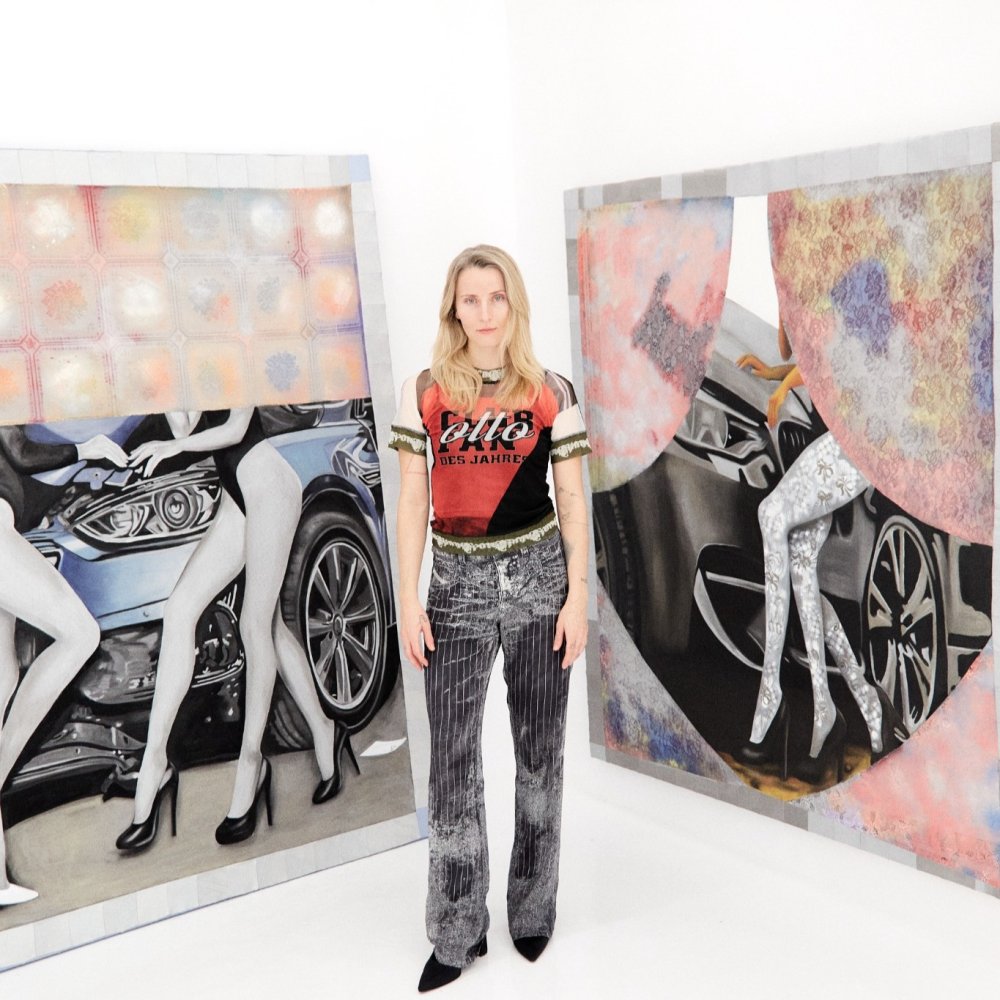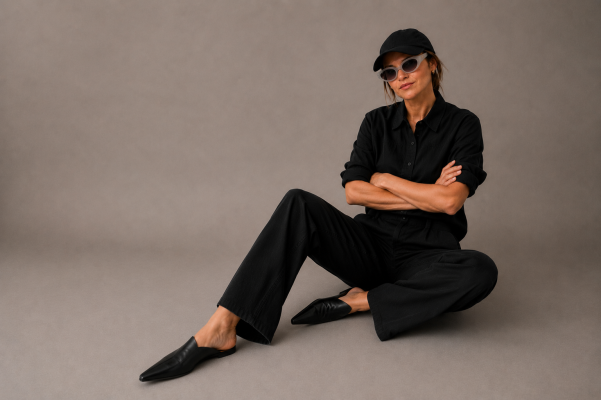
Magda Danel is the director and chief curator of the František Drtikola Gallery in Příbram. She has a long-standing experience in the field of contemporary art, cultural management and the development of public cultural institutions. In the past, she worked as a film producer at VICE Media, and externally collaborated with Czech Television, the Prague Castle Administration and a number of important cultural organizations, festivals and artists. She also worked as the director of the cultural contribution organization of Prague 3 and the commercial director of the law firm Suchanová Mečl Legal.
In her work, she focuses on the relationship between contemporary art, public space, and community, as well as the possibilities of the gallery as a place of dialogue, education, and interdisciplinary collaboration.
You joined the František Drtikol Gallery as director at the beginning of 2024. Do you remember the first moment in Příbram when you said to yourself, "I can really build something here"?
In my life, I place a lot of emphasis on the first intuition connected with a place. It's either love at first sight, or I move on. The gallery building in Příbram was exactly the first case. I immediately saw huge potential in it, even though it was clear to me that the path to its fulfillment would be long. And unfortunately, it is precisely such challenges that I cling to like a moth to a flame. So I commute from Prague to Příbram and I love it.
The gallery bears the name of František Drtikol, but at the same time it has the ambition to be a contemporary living institution. How do you think it is possible to work with such a strong historical name without closing the gallery to the past?
The gallery is named after an artist whose story is not black and white, who was not afraid to leave his comfort zone, go out into the world and, after great success, return to his roots - both inner and to the place where he was born. I think contemporary art needs exactly the same courage. Therefore, I do not see the name of the gallery as a reminder of the past, but as a challenge to cross one's own boundaries and not be afraid to go back to one's roots.
This is what I think is often missing in today's galleries. Instead of searching for substance, they too easily succumb to trends and the desire to be attractive. But this is a difficult topic.
In an interview with Art2Friends, you talk about how a city gallery's exhibition plan must consider a broad audience, community function, and tourist attraction. Where is the line between openness and programmatic compromise for you?
A programmatic compromise occurs when an institution starts changing the very content of the program just to increase attendance, satisfy political mandates, sponsors, or current audience demand. In other words, when the selection of artists ceases to be based on a curatorial concept and starts to be driven primarily by marketing. Such work would make no sense to me at all.
Openness means that the gallery strives to be accessible to different groups of visitors. It seeks different forms of interpretation, education and communication without reducing the demands on the content. Openness concerns primarily the method of mediation, not the quality of the art.
Then there is only the taste and feeling of the chief curator. He is the one who decides where we are still talking about art and where we are not. We all set this boundary differently, which is why galleries differ from each other. And I think that is a good thing. Every public gallery institution or private gallery gradually creates its own audience.
With commercial galleries, the market and the personal preferences of the gallerist come into play, which is a natural unregulated environment that inspires me in many ways. I enjoy watching it all and I welcome all this diversity. Unfortunately, I also see a lot of hatred and hate that sees different approaches as a problem. I have reached a point where I welcome this diversity of perspectives and sources.
Not everything is for me. But I like to be surprised by something where I least expect it. And those moments are often the most powerful.
How do you actually compose the gallery's dramaturgy today?
I have been working in the field of contemporary art for 20 years. The basic principle that I look for in my work is simple. I am primarily looking for the artist's honesty towards his own work. I am interested in an uncompromising approach, the truthfulness of content and form. The viewer should be able to find his own interpretation. I compose the dramaturgy of the exhibition plan based on many criteria that I evaluate over time. For solo exhibitions, I often leave the choice of curator to the artist, for thematic group exhibitions I look for a curator who has followed and developed the given topic in his work for a long time.
As a director, I manage the public funds of the city gallery, so my first criterion is the Příbram audience, whom I have tried to understand and respond sensitively to their needs and expectations during the two and a half years of my work, but without the above-mentioned programmatic compromises. We have managed to increase the number of visitors to include both local and non-local audiences, which was my goal in the first years of my work in Příbram. I had to put the brakes on some of my ambitions, and step on the gas again in others. If I were running a private gallery, my dramaturgy would be much more narrowly profiled.
But there are many criteria, managing a small gallery-based grant organization is not an easy task. Thanks to an excellent team of employees, external experts and people who have supported the gallery for a long time, not least politicians in the city hall and in the opposition, it has been successful so far. In Příbram, I have the advantage that I am continuing the strong tradition of a city gallery that people are used to going to and which has its importance in the city, this is not a given.
Are you managing to reach out to more foreign or domestic curators?
We are not yet mature enough for that, but it is definitely our goal. It will take several years before we can afford to invite more foreign curators and at the same time offer Czech curators appropriate conditions. I can afford external curators once, at most twice a year, and I try to offer them decent conditions, but I cannot afford to go above the standard compared to other Czech institutions. And here begins the vicious circle.
Our exhibitions cover an area of almost 600 m2. This is a huge space that requires months of intensive work on each exhibition. However, the work of curators has long been financially undervalued in our country. As a result, they are forced to accept a larger number of commissions, and so they often cannot devote as much time to large-scale projects as they deserve.
That is why there are very different ideas about what the work of a curator actually means. Someone is present from the first draft to the last detail of the installation, another writes the text and comes to the opening. Both are legitimate. I prefer the first approach – curators who are partners of the gallery and the artist throughout the entire preparation period. However, I am not yet able to offer them conditions that would allow them to devote as much energy to this work as they deserve. I am thinking about how to change this situation, in this respect the Czech environment is sick and uncompetitive compared to foreign galleries.
In the aforementioned interview, you also talked about a series of exhibitions whose central theme is childhood. Will you continue with it this year or next year?
This year we took a break from the topic of childhood. The topic was space and place. Next year we will open the topic of death, which is very closely related to childhood. In fact, we will naturally follow it up.
The exhibition Inherited Animals (2025), from the aforementioned cycle, by Libuša Niklová and Petr Nikl, showed that a gallery can be accessible to both children and adults, without losing its artistic weight. Did this experience change your thinking about who the gallery is intended for?
In my opinion, the city gallery should be open to all generations in principle. As a little girl, I was familiar with this approach from foreign galleries, and it was there that I found my lifelong relationship with contemporary art. All of our exhibitions are regularly attended by pupils and students from kindergartens, primary schools, secondary schools and universities. I think that Czech society owes a certain debt to the visual arts. During my childhood, we went to the theatre, concerts or cinema with our school, but galleries were rather left out.
With the exhibition Inherited Animals, together with our educational platform STUDIO GFDP, I wanted to open the gallery to children and their parents with content and form that in themselves represented generational continuity and exchange. Libuše Niklová's work was strongly influenced by her then young son Petr Nikl, just as Petr Nikl's work is influenced by his mother. This relationship was a great inspiration to the visitors of the exhibition, as was its thirteen-year-old autistic curator Daniel Bouška. It was an exceptional exhibition project that launched the activities of Studio GFDP, which today offers more than 200 accompanying exhibition programs per year, not only for young people.
We offer children and students the experience of a gallery as a place where they don't have to be afraid to ask questions and find their own answers. Our lecturers always tell children that no answer to the question of what they see in a work is wrong. We want to awaken in them the desire to read art in their own way, to have a dialogue with it and to develop critical and abstract thinking. In this sense, I see the gallery as a safe and cultivated space for everyone, even in the case of controversial content, which we are not afraid to show to children.
Last fall you also presented Taja Spasskova's exhibition Matter of Absence. Her work was also featured at the Telegraph Gallery as part of the exhibition Connection (2023) and at her Open Studio during her residency. What convinced you to have a solo exhibition in Příbram?
Personally, I am very close to drawing. The nudity of paper and pencil moves me like few other things.
Taja Spassková's drawings are almost a revelation to me. They embody a theme that has long fascinated me across music, film and visual arts – space, place, matter, emptiness, sound and silence.
I have long been involved in the management of new (contemporary) classical music, and later also in dramaturgy, where authors such as Morton Feldman or Kaija Saariaho were absolutely crucial for me, as was Samuel Beckett in literature. Taja Spassková is for me one of the most prominent artists of her generation working with these themes, which I find in an exceptionally strong form in her work.
Taja and I have been preparing the exhibition for a year and a half. During these preparations, our team also visited her at the Telegraph Gallery during her residency, which was very important for the creation of the exhibition, as was the loan of her work from the Robert Runták Collection. I always welcome cooperation with the Telegraph Gallery and look forward to the next one.
An exhibition by Marek Thero is scheduled to appear at the František Drtikol Gallery in 2028. His work often creates an entire environment, almost a cinematic situation. What interests you about him as a director and curator, especially in the context of Příbram?
Film is one of my great passions. I am fascinated by the work of the camera with space and sound. In my opinion, it is the work of film with space that fundamentally influences the emotional memory of the last few generations.
Mark Ther applies these aspects in his work. His installations, the transformation of space, his work with the memory of place and reflection – all of this has interested me for a long time. I am really looking forward to what he will create at GFDP. It will be an installation in three wings of the gallery, so it is a demanding project that requires a longer preparation time and will be realized in 2028.
Mark Ther can work with memory, stylization, strangeness, and taboo topics very precisely, but at the same time powerfully for the viewer. With his future exhibition, are you thinking more about what he will bring to the gallery space, or what his work can bring to the gallery and the city?
It is this mutual dynamic that interests me.
Working with place and space is essential for me in every exhibition. With Mark Thero and curator Mira Macík, we are just at the beginning. On his last visit, Mark spent the whole day in the gallery, in the city and on Svatá Hora. In the end, he took home a large ceramic pheasant from the Příbram Antiquity. So I believe we are on the right track.
Both the Telegraph Gallery and the František Drtikol Gallery are located outside the center of Prague, but both strive to bring distinctive contemporary art to an audience that is not necessarily just professional. Do you see a greater need for cooperation and mutual monitoring among regional institutions today?
Absolutely. I come from the region myself, I was born and raised in Třinec. I see the region as an extremely important part of the map of contemporary art.
I often feel that it is in the regions that contemporary art finds its way to people more naturally than in Prague. Prague offers a huge number of cultural opportunities, but their quantity does not always correspond to the quality I am looking for.
I think regional galleries should talk to each other a lot more, share experiences and have the courage to take on projects that they would have difficulty implementing on their own. I see great potential in that.
At the same time, I see one fundamental thing. My children no longer perceive the region as something fundamentally different from their native Prague. They are Europeans and a good gallery is an equal place of inspiration for them in Olomouc, London, Příbram, Paris, Česká Skalica, Milan, Broumov or elsewhere.
When you look at the program you are preparing for the next few years, what is the biggest challenge for you: finances, time, space, audience, or maintaining your own energy?
Time and trust of the audience and the founder.
In order to be able to complete projects in Příbram that require years of intensive work and continuity, I need both. Whether we are talking about the restoration of a cultural monument in which the gallery is located or about major exhibition projects, it will always be about people's trust.
Everything else can be obtained much more easily. Trust is the foundation for me. I always build on it and it must be mutual. When it is missing, it is time to move on. This applies both at work and in personal life.
And finally, which exhibitions can visitors look forward to in the near future?
At the end of September, we will open the exhibition INVENTURA , which will present the 1990s of collector Karel Babíček with a selection from his Behémót collection. The collaboration with collector, gallerist and curator Miroslav Jiřel and collector and curator Karel Babíček is a project that brings me a lot of 1990s energy. It will not be an art historical definition of this decade, but rather an emotional map of the Behémót collection.
At the end of this year, we will have an exhibition by Robert V. Novák. Robert is also a collector, and we are all looking forward to his great theme of the sphere.
In the spring, we will open a solo exhibition NAMOR , by Roman Výborný.
We are so looking forward to all these exhibitions at the gallery that I believe that our energy and enthusiasm will be contagious enough to bring even those who have not visited the František Drtikol Gallery to it. Thank you for your questions and see you at Telegraph or in Příbram.