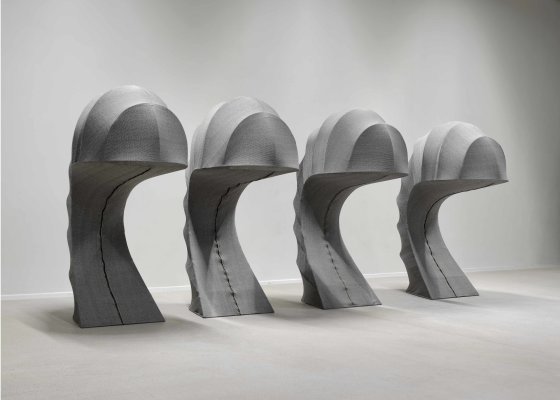
Collecting, as a phenomenon, has many facets, forms, and variables. All these components that make up the whole are, as is often the case, accompanied by numerous stereotypes and preconceptions. Many people who acquire fine art, for example, claim that they must “come of age” before collecting sculptures. An even higher tier consists of sculptures—or rather, objects—that are, shall we say, oversized. Understandably, a collector who lives in a standard apartment with his family will not acquire a series of larger-than-life sculptures. On the other hand, such spatial limitations no longer apply to a relatively broad group of significant collectors of the post-war scene. There remains a deeply ingrained notion that truly large-scale, often iconic objects and installations—particularly those created after 1989—are somehow destined primarily for state institutions or, as is often said, for “museum collections.” The monopoly on large-scale art continues to be “consumed” in the traditional manner, even though, in many cases, the conditions for its storage are far from adequate.
The exhibition SIGNAL V from the Robert Runták Collection pursues a very ambivalent ambition. Its aim is to present a selection of iconic, and mostly very large-scale installations in a relatively small space. Beyond that, it seeks to demonstrate to many other collections the feasibility of this “approach” and mode of thinking. To suggest the possibility of absorbing major works in dimensions that significantly exceed established conventions. In a sense, it represents a certain kind of departure from the established comfort zone of collecting. From countries with developed collecting traditions—where continuity of ownership, freedom, and collecting in general has not been interrupted—we know of cases in which owners live with large-scale installations in their most intimate of spaces. They are surrounded by them on a daily basis, with video loops running continuously—quite naturally, almost automatically.
The goal of this imaginary game should always be the same—to acquire an iconic work that permanently and fundamentally represents the artist and, if possible, also a particular phase in local art history—regardless of its scale or the practical conditions of storage and handling. Beyond this general premise, however, a specific situation emerges: the creation of a unique setting in which several autonomous works are brought into close proximity—works that, by virtue of their significance and especially their exhibition histories, rank among the fundamental works of Czech art after 1989. In new perspectives and interactions, the exhibition will present Plumbař by Krištof Kintera, Heat Wave by David Možný, Billboard by Jiří Příhoda, and Helmets by Milena Dopitová—a series of dominant, solitary, and iconic works. The exhibition is further intersected by a second conceptual layer based on the contrast and dialogue between works that share a related conceptual or philosophical structure. As is often said, history should be told as a story. And it doesn't really matter whether that history happens to concern art.