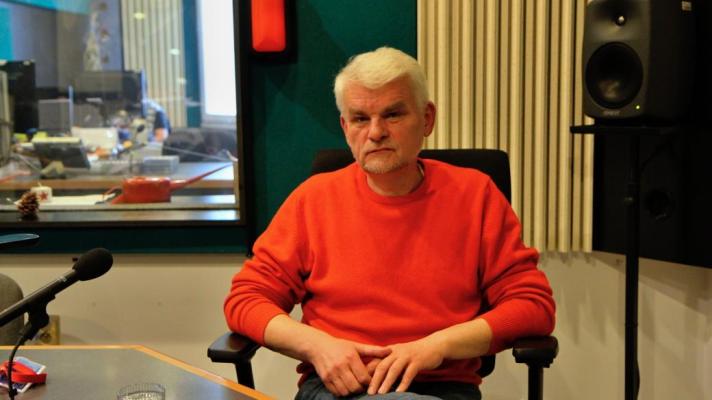
Ladislav Daněk (*1958, Přerov) studied Czech language and art education at Palacký University in Olomouc in 1977-1979. After two years of study he left his studies and until 1990 worked in various working-class professions and socialised with artists from the semi-official and unofficial scene. Since 1990, he has been a professional worker at the Museum of Art Olomouc - Museum of Modern Art and Central European Forum (SEFO), where he works as a curator of exhibitions and sub-collection of the collection of 20th and 21st century paintings. Between 1999-2009 he studied Theory and History of Fine Arts at the Faculty of Arts of Palacký University. Outside of his curatorial career, he is an art historian. With his paintings and drawings, he follows the geometric tendencies of the 1960s as well as a spiritually meditative work, or understanding art work as a kind of spiritual practice. In 1991-1998 he was a member of the Association of Olomouc Artists, in 1997-2005 of the Olomouc section of the Concretists' Club 2. Since 2012 he has been a member of the Concretists Club 3. His works are represented in both Czech public and private collections in the Czech Republic and abroad.
Ladislav Daněk will be presented together with Jakub Sýkora and Rita Koszorús on 1 February in the first presentation of a lecture series entitled Artist Presentations.
I read that you did not finish your studies at the Faculty of Education at Palacký University in Olomouc because of the prevailing atmosphere. Could you elaborate on that? And when exactly was the moment of realization that you did not want to continue your studies?
First of all, it should be mentioned that I entered the university six months after the Charter 77 speech. I belonged to the so-called experimental year of the combination of Czech language and art education, so we had part of our teaching at the Faculty of Arts and part at the Faculty of Pedagogy, but tribally we fell under the Faculty of Pedagogy. There was a stuffy atmosphere at that time, because the teachers were worried about their jobs because of the hardening of the regime after the Charter, so especially the teaching of art education was marked by the creation of "benign art" in the spirit of some derivative of socialist realism. Moderately expressive handwriting was considered the height of courage. To illustrate the deviousness of the times, I like to mention the story that when I made a request to introduce the teaching of nude drawing at the "pajdák", it was rejected by the head of the department, Professor Dušan Janoušek, on the grounds that "it is undignified to have a naked woman on the premises of the Faculty of Education." And so I went to the evening drawing in the studio at the Faculty of Arts in Wurmova Street, where there was a pleasant working atmosphere thanks to the great painter Miroslav Štolf. In the art class we were supervised by our year leader and a precious woman, graphic artist Jana Jemelková. In the second year, however, I was expelled from the school after a certain conflict with the head of the Marxism-Leninism department, which took place between the four of us. I must say, however, that I was not an exceptionally gifted student, I was just quite stubborn and wanted to go my own way, preferably with a straight spine.
Since 1990 you have been working at the Olomouc Museum of Art. How did you get this job?
I was lucky for the time. Back in November I was still employed at the theatre, where I had worked for ten years as a stagehand in an opera company, but right at the end of the new year I was offered a job by the then director Pavel Zatloukal, asking me if I would like to join the then gallery (now the Museum of Art) as a depository and installation worker. I accepted the offer without hesitation, as I did not want to be a set designer for the rest of my life. After about a year, the director asked me if I wanted to curate and participate in the preparation and realization of exhibitions, and that's how it all began. Eventually I also started writing texts for catalogues and became curator of the collection of paintings from the second half of the 20th century.
In 1999 you started studying at the Faculty of Arts, Theory and History of Fine Arts. How did you manage to combine your demanding studies with your work?
I studied full-time, as no other form was possible at the time. The first year I "dropped out", then I was given an individual study plan. It was challenging not only for me and my family, but certainly also for the teachers, as I was already professionally determined, so many exams were literally hellish for me. I must add with gratitude that the museum management and my colleagues were very supportive during my studies.
Did you decide to pursue this field through your work at the MUO? Did you consider completing your studies at the Faculty of Education?
When the so-called revolutionary years passed, it became clear to me that it was necessary to complete my studies. The Department of Art Education did not come into consideration as it was focused on educating teachers. After all, there was no reason to complete it for other reasons as well, since I was already a "finished artist," so to speak.
In your bachelor's thesis you discuss the work of Jiří Lindovský. Was he an inspiration for you in geometric drawing?
At the time when I was looking for my own artistic path, i.e. in 1979-1983, I gradually got acquainted with the entire so-called unofficial, or semi-official, Olomouc art scene. That is, also with Jiří Lindovský. However, I visited him for the first time in his basement studio with my friend Vladimír Havlík in 1983, when I was already drawing on millimetre paper. Jiří Lindovský was even generous enough to exchange three of his prints with me for one of my drawings. That was a huge encouragement. I've always been fascinated by his work, but I don't think it influenced me directly. I'm just finishing the introductory study for his monograph, in which I'm trying to make the case that Lindovsky is a hidden genius. His work to date is unparalleled even in a European context. Among other things, as early as 1978, he dealt with the subject of the creation of the technological image in a series of drawings and paintings entitled Diaphragm or System with Screen, which from today's perspective seems like a pioneering act. However, his contribution to the treasury of art did not end there, but on the contrary has only just begun. But back to your question. In those years I was partly influenced by the drawings of Václav Stratil and especially by the work of Václav Boštík, whom I first met in early July 1984. At that time, Vladimír Havlík, Václav Stratil and I visited a number of unofficial artists in Prague whose actual work I did not know. During our week-long stay we visited Adriena Šimotová, Stanislav Kolíbal, Karel Malich, Hugo Demartini, Milan Grygar, Jitka Svobodová, Jiří Mrázek, Radoslav Kratina, Vladimír Kopecký, Josef Hampl, Stanislav Judl and Magdalena Jetelová, who emigrated to West Germany a month later. From that meeting onwards, I visited Boštík once or twice a year in his studio in Pařížská Street and consulted him about my new drawings.
My second patron, if I may say so, was Jiří Valoch, a theoretician from Brno and a remarkable author of visual and conceptual poetry. He was the only one who followed my work regularly. It was interesting that he never said anything about my drawings, but his visits were a great encouragement to me. You could tell that he liked the drawings only by the fact that he nervously began to tug at his beard. Besides that, he also put me and Vladimír Havlík in contact with many other unofficial artists. Visits to Czech, Moravian and Slovak studios were a kind of private university for me. I am still very grateful to him for that.
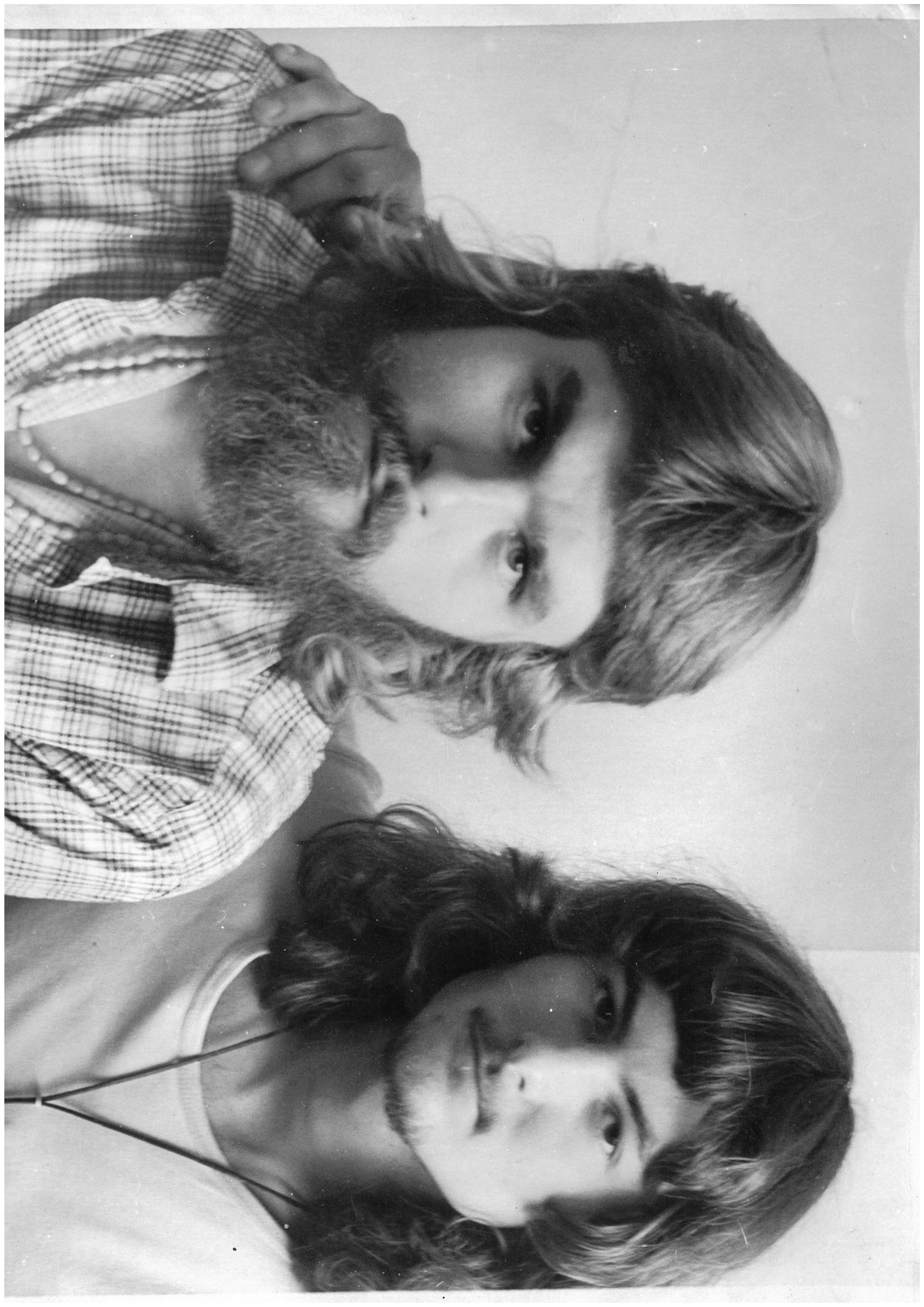
In your master's thesis, on the other hand, you wrote about the work of Slavoj Kovarik. Why him?
I was introduced to Slavoj Kovařík sometime in the early 1980s by Václav Stratil, who took me to his studio in Ztracená Street. With the exception of Václav, none of the younger artists visited him. He worked in seclusion. I was very interested in his work, so I was surprised when Václav revealed to me after the visit that the artists nicknamed him "Olomouc Rauschenberg" in reference to the American pop-art protagonist Robert Rauschenberg, which I found derogatory and unfair. Years later, in 2000, I arranged for Kovařík's first major retrospective at the Museum of Art, which I think clearly demonstrated that Slavoj had been the most progressive artist on the local scene since the early 1950s, but that his seminal work from the 1950s-70s is still not properly appreciated on a national scale. The blame lies with the fact that after the aforementioned retrospective his best works have gone who knows where, so that it would be extremely difficult to prepare a critical monograph of his extensive oeuvre today.
You devote yourself mostly to geometric drawing. When did you develop this predilection for "rulers"?
The very beginning dates back to the autumn of 1979. At that time, during my night wanderings through the darkened Olomouc, I was so fascinated by old paving stones that I brought a few of them to my studio, placed them on the table in the morning instead of the traditional still life and started to capture them, but with a deliberate violation of perspective and with a technique that was not acceptable at the university - an ordinary blue pen. In the drawings, my main concern was to challenge the perspectival grasp of space. Later I replaced the paving stones with matchboxes. Also with these drawings I was interested in making them appear natural at first glance, but in reality unreal. Then I went back to minimal linear ink drawings of blocks whose scale could be perceived as tiny or, on the contrary, gigantic. Gradually, I intuitively moved the blocks from the center of the paper to its edge, until one day I realized that the relationship between the edge of the paper and what was happening inside the surface was an exciting artistic problem. It got to the point that in the "simplest" drawings, the edge of the paper was also one edge of the block. The thematization of the boundary of the transition from surface to space still interests me to this day, in a way. It was only a short step from that to one day reaching for a ruler.
I was curious to see if even using a ruler the drawing would hold its emotional impact. I soon realised that the wall of the cube, if you strip away its spatial dimension, is nothing but a square. And so I began to explore the emotional differences between hand-drawn and drawn squares that floated in a kind of indefinable space. That's when I found myself closest to the work of Václav Stratil. For a time we saw each other almost daily, and the subject of the square was still being addressed together with Zbyněk Kulvait, who at that time was creating remarkable spray-painted illusionistic reliefs. But the decisive moment for my further work was the following year (1983), when Václav was already living in Prague. From squares traced on white paper I quite quickly developed to working with millimetre paper. At the same time, my friend Nora Pražáková was working with my drawings on millimetre paper, but instead of a ruler she used only a compass, so our work was complementary. Her almost forgotten drawings are excellent.
You avoid comparing your work to "op-art". However, have you found any inspiration for your drawings here?
I have great respect for op-art. Alongside the well-known names of Victor Vasarely, Bridget Riley and Jesús-Rafael Soto, I greatly admire Richard Anuszkiewicz and Ludwig Wilding, whose optical moiré fascinate me and are the closest to me artistically. However, I have never looked for direct inspiration in op-art and I think it is obvious that my drawings are not about optical illusions, but about making present a certain spiritual content, based at the core on simple combinatorial operations, which, however, offer a plethora of variations. The important thing is therefore to keep in mind the meaning of the thing, not its aesthetic aspect. Even so, a lot of drawings fail. But if I stick to a properly chosen system (an imagined order), the drawing slowly emerges from its prenatal state. I don't really consider myself a draughtsman in the true sense of the word, and certainly not an artist. I am rather a "birthing artist". There is another interesting problem with this. I call it the hand-computer argument. I couldn't try generating drawings by computer in my conditions, but I was always and still am convinced that the hand as a tool is irreplaceable. In this I am a traditionalist, and I find the notion that my drawings can easily be done on a computer utterly ridiculous. Not to mention that I progress "to the finish line" much faster and more organically than the computer, or whoever controls it.
Basically, I've been wondering the same question for over forty years: is it possible to capture on a piece of paper or canvas a sense of "cosmic order" that I can't put into words? So far I have come to the conclusion that the clearer the rules I choose, the more surprising the result. This keeps me so excited that I don't feel the need to change the constants of my work. So I make do with just a ruler, a pencil, possibly colored pencils, and a millimeter paper. As I mentioned before, I am not attracted to computer work. Each drawing has a different coding, so using the computer as a tool would be unnecessarily tedious. With slight exaggeration, I claim to be faster than the computer. My drawings can also be seen metaphorically. And metaphorically in a double sense. Firstly, the drawings can be seen as a kind of report of a mental detachment from one's own ego towards an understanding of the world. And secondly, it is a completely opposite direction. That is, a descent into one's own inner self, the purpose of which is to understand oneself through the resulting image. This is, among other things, the essence of mandalas. But it is obvious that one path without the other is meaningless. If the resulting drawing is beautiful, so to speak, it is not really my merit, but the merit of someone else. The mystery of true beauty is such a fundamental question for me that I think day after day about what mystery lies "between heaven and earth". Through drawing I have come to the conclusion that the world is one structure, incomprehensible only to human reason, which is infinitely more multifaceted and colourful than we can imagine.
You have been a member of several art societies, can you name them? Do you feel that being active in any of them has been crucial to your work?
In 1991-1998 I was a member of the Society of Olomouc Artists, grouped around Galerie Caesar. The gallery is still alive today, but the association gradually became a sleeping Beauty, so I left it. On the other hand, the following eight-year membership in the Olomouc section of the Concretists' Club 2 was great. On the initiative of the art theorist Arsén Pohribný, I co-founded the club with the sculptor, painter and graphic artist Zdeněk Kučera, who was a member of the original Concretists Club, active in 1967-1972. We were quite active, exhibited a lot, and regularly met in the legendary Bistro Na hradě, where we also held exhibitions for kindred spirits. I left the club because of a difference of opinion, which is common in a community of strong individuals. In fact, it is surprising that the club was active for ten years. As far as the influence on my work is concerned, it only manifested itself in the fact that I drew more and had someone to discuss with about art that interested me, for example the great Polish geometric scene, which I had the opportunity to get to know thanks to my work in the museum.
If I'm not mistaken, you are an active member of the Concretist Club 3. Do you have any regular meetings?
I have been a member of KK3 for ten years. It was founded by friends from Hradec Králové, namely the sculptor Štěpán Málek, who studied with Stanislav Kolíbal, the theoretician Martina Vítková and the tireless promoter of the club's activities, the curator Jana Vincencová. It is mainly thanks to them and their extraordinary dedication that this stream of geometric art is still alive in our country, as they have managed to bring a number of young artists to the club. This trio organizes various joint meetings, but to my own detriment I did not attend any of them. I am one of the older, inactive members, so I expect to be deservedly dropped soon. My colleagues probably had some theoretical hopes for me, but unfortunately I don't have the time for that, and besides, although many people think so, I am not primarily concerned with the theory of various geometric tendencies. I prefer to write about forgotten but remarkable artists. In other words, I'm interested in basic research and topics or artists about whom not much is known.
You have been involved in more than a hundred monographic and group exhibitions. Which do you think was the most difficult to prepare for?
Probably the most challenging was putting together the exhibition of Hungarian postwar art that our museum put together in 2003 in collaboration with the Székesfehérvár Museum, which has an extraordinary collection of Hungarian neo-avant-garde and postmodern art. So my colleague and I went to Hungary for a week to prepare a selection of exhibits, both of us knowing only about three or four Hungarian artists, led by Victor Vasarely. The agreement with our Hungarian colleagues was that we would go through all the depositories and choose what we thought was the best, which we would then make into an exhibition with a big catalogue. On top of that, there was the Hungarian language, so it was quite difficult to get along. My colleague spoke quite bad English, I spoke even worse German and it was similar on the other side. But we were united by our enthusiasm for art and the desire to learn something essential about a culture so geographically close and at the same time quite distant from us in terms of art. We spent whole days from morning until late evening in the depositories, picking out exhibits, which was exhausting but extremely exciting. At the end of our stay, we had to present the selection of exhibits and the concept of the exhibition to Márta Kovalovszky, one of Hungary's most important historians of post-war and contemporary art. When I was finalizing the concept the night before, I suddenly fell asleep with fatigue and hundreds of images ran through my head, including the names of the artists, which were completely fictitious! My brain was so exhausted that it started creating things that didn't really exist. I woke up in horror and was happy to see an almost finished spatial concept of the exhibition with real names and works on my desk.
You are a regular visitor to the Telegraph Gallery. Which exhibition left the biggest impression on you?
First of all, the Telegraph's work is extraordinary in every way. It's hard to pick one title, indeed I haven't seen all the exhibitions. In addition to the exhibition of contemporary German painting and the solo presentation by Radu Bais, after much deliberation I chose to show a series of views into the collection of Robert Runták, the most interesting of which for me was the recent Signal III in an impressive and provocative installation by Mark Thera. Only I cannot forgive him for the way he treated Kupka's painting, which belongs to the world's treasure trove of abstract art, so from my point of view it cannot be treated arbitrarily. Otherwise, Thero's solo exhibition, or rather installation, was also impressive. On the other hand, in my opinion, the opening exhibition by Václav Stratil was not a success, as it attracted the local audience, but unfortunately it was poorly chosen.
Portrait photos by Petra Ševců, Czech Radio; Jaroslav Vacek, photographer