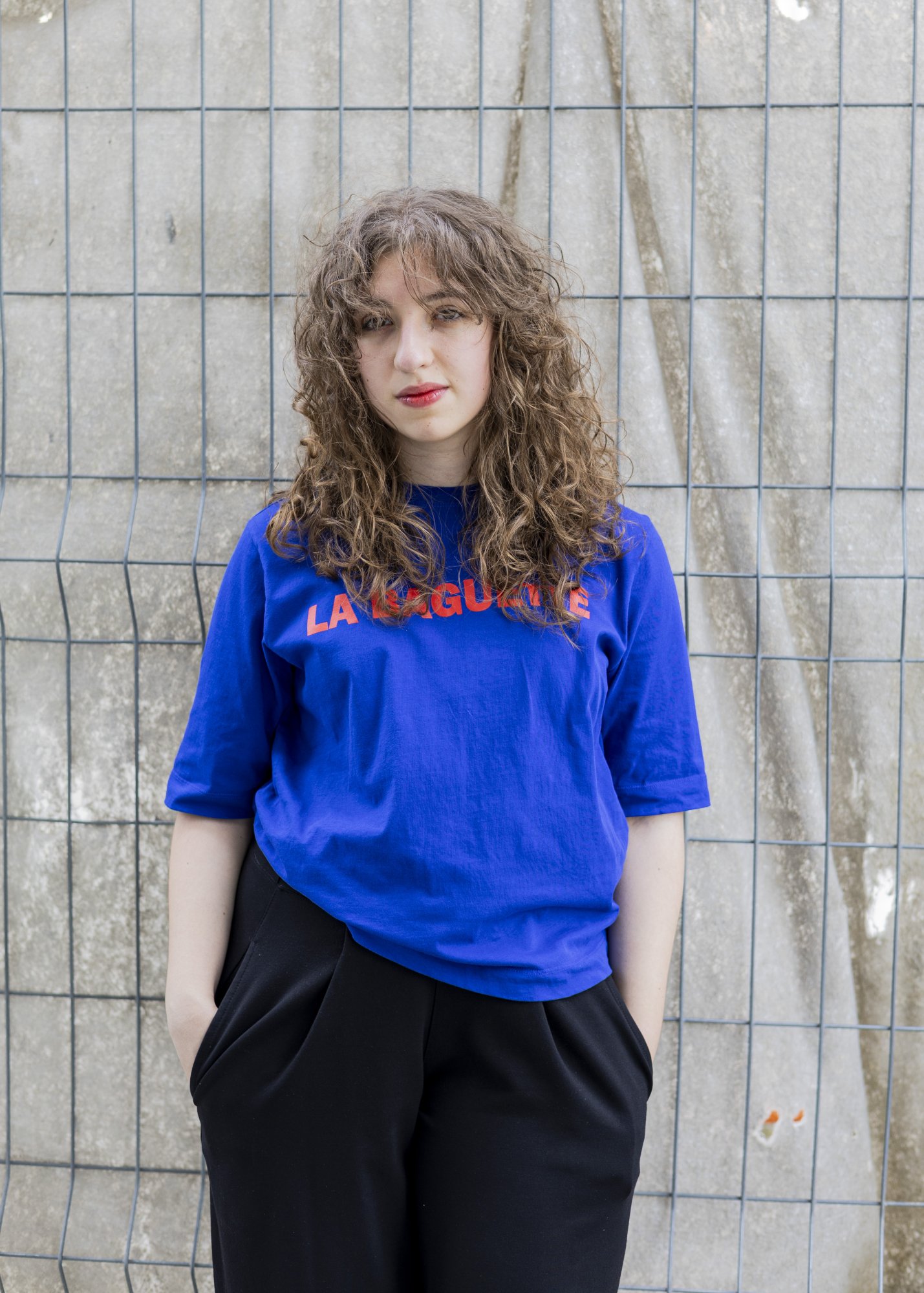
Karolína Stella Zímová (Berry26) is a Czech illustrator, comic book author and student of the Ladislav Sutnar Faculty of Design and Art at the University of West Bohemia in Pilsen. In her work, she combines personal themes with the visual language of Japanese manga and approaches comics as a cinematic narrative through images. She finds inspiration across artistic disciplines – from music to film to fine arts – whose rhythm, atmosphere and emotions she transforms into her own comic book world.
In 2024, she exhibited her author's comic RESET THROUGH A BLANK CANVAS as part of the Open Call of the International Comic Festival KOMA in Brno and participated in the Road 2 Expo project during the presentation of the Czech Republic at EXPO 2025 in Osaka, Japan. In 2026, she presented her work at ComicCon Prague, where she led author's workshops. In the fall, she will again be a guest with them in the illustrator section of ComicCon Brno, where she will also present to the public for the first time samples from her upcoming author's comic A Forest.
The interview was created as part of the Telegraph Film Festival 2026 / TEFF26: FEMMES FATALES , where Berry26 will speak on Friday, November 13 at 5:00 PM with a lecture on Comics as Direction .
Over 26,000 people follow you on social media under the name Berry26. How did this pseudonym come about and what does it mean to you?
The name Berry26 actually came about completely by accident when I was nine. My younger sister and I needed to come up with a nickname for the game Just Dance 2016, and Berry26 was born. I gradually started using it everywhere, including my first social media profiles, where I've been sharing illustrations since I was twelve.
I never thought of the name as some kind of deliberate artistic brand. It just grew with me. Today, I can't even imagine presenting my work under any other name.
At TEFF26 you will talk about comics as a series of directorial decisions. When did you first realize that you were actually “directing” when you were drawing?
I think I only fully realized this while working on my current comic, A FOREST. It's a larger story that requires me to focus much more on the composition of each page and especially on how the scenes connect.
Japanese manga has always fascinated me with the way it works with movement and time. It often devotes several panels to a single gesture or brief moment, while American comics can push the plot much further in a similar space. It was while working on A FEREST that I began to realize more and more that I actually make decisions similar to a film director. What do I show the reader, from what angle, how long do I keep them at one moment and when do I lead them to the next scene.
Comics are also close to film in practical terms. When shooting commercials or films, a storyboard, i.e. a drawn script, is commonly used. For me, it's interesting to think of a comic page in a similar way – as a series of shots, the arrangement of which I can influence how the reader will experience the story.
You draw inspiration from music, film, and visual art. Which films or directors have influenced you the most, for example in your work with the rhythm of the page or composition?
Films are a huge source of inspiration for me and I often return to them precisely because of how they are visually constructed. The directors who influence me the most include Wes Anderson, Quentin Tarantino, Sofia Coppola, Spike Jonze, David Lynch and Miloš Forman.
I'm fascinated by Anderson's films for their precise composition and work with visual symmetry. Tarantino is interesting to me for how he can build tension, work with dialogue and the pace of the narrative. I'm attracted to Sofia Coppola's atmosphere and ability to express emotions even through seemingly ordinary moments.
Films like Pulp Fiction, The Hateful Eight, Kill Bill, The Grand Budapest Hotel, Bullet Train, Whiplash and Lost in Translation are essential for me. I was also very touched by The Odd Family and The Infamous. I notice how directing achieves a certain effect on the viewer through different means, and I wonder how similar principles could work in comics.
This year's TEFF is dedicated to femme fatale women. How do you perceive the femme fatale character? Is it more of a cliché for you, or an archetype that still has something to offer today?
The femme fatale is considered an archetype that has historically been associated with negative connotations. She is often portrayed as a dangerous or manipulative woman who leads others to ruin. However, I see her a little differently.
To me, a femme fatale is a woman who enters a story and can fundamentally change its direction. She is not just a passive part of the plot, but she influences it herself. She wants more from life and from her story than just accepting what is happening around her.
This archetype is sometimes pointed out by teachers during lectures (study at the UWB Faculty of Arts, Ladislav Sutnar, atelier Comics and Illustration for Children) and I find it interesting how its interpretation changes. Personally, I am much closer to the concept of femme fatale as a woman of fate than a deadly woman. She does not necessarily have to be destructive to have the power to change the story.
The festival is dedicated to women "who are not forgotten." In your work, you focus on the psychology and movement of the characters who carry the entire narrative. What do you think makes a drawing a character that the reader will remember?
From a purely visual perspective, one of the best tests of a character's memorability for me is their silhouette. If you reduce a character to just a black outline, they should still be recognizable, at least within the context of the comic. That means they have some characteristic proportions, hairstyle, clothing, or the way they move.
At the same time, I think that a striking design alone is not enough. It has to make sense in the environment and time in which the story is set. A character can wear very atypical clothing, but if it doesn't fit into their world at all, they can lose credibility.
I therefore try to find a balance between originality and fidelity to the world the character lives in. And of course, it is important to me that behind the interesting appearance there is also a personality that the reader gradually gets to know.
You connect personal themes with the visual language of Japanese manga. Do you have a prominent female character in manga or anime that has shaped you as an author?
Two characters come to mind in particular. The first is Asirpa from the manga Golden Kamuy. She is a young girl from the Ainu people, the indigenous people of northern Japan. The story takes place in the early 20th century, during a time of significant modernization in Japan, when the traditional Ainu way of life was coming under increasing pressure.
What fascinates me about Asirpa is that she is able to maintain her own opinions and make her own decisions about her life, despite the expectations of her community and the majority of Japanese society. I see her as a representative of a new generation that respects her roots but does not want to be limited by what is expected of her.
The second character is Jolyne Cujoh from the sixth part of JoJo's Bizarre Adventure. Her story is of course completely different, but I admire her determination and wit, with which she can face even seemingly insurmountable situations.
Both characters are important to me mainly because they are not dependent on someone saving them. They can fight for themselves, make their own decisions and bear the consequences. It is these kinds of female characters that interest me as an author.
In the comic Reset Through a Blank Canvas, which you exhibited at the Open Call of the KOMA festival in Brno in 2024, you explore creative identity through the character of Vincent van Gogh. Why him?
This comic was created during the 2024 holidays as a response to the festival's Open Call theme, which was RESET. In June of that year, I visited the Van Gogh Museum in Amsterdam, where I was intrigued by the archive of letters that Vincent wrote to his brother Theo.
In one of these letters, Vincent addressed his own creative crisis and his relationship with the blank canvas. This motif immediately caught my attention because a blank canvas or a blank page can represent both a tremendous freedom and an obstacle for an artist.
I found this to be a very powerful way to approach the theme of reset. Not as some dramatic new beginning, but as a moment when one stands before a blank canvas, has to overcome one's own authorial doubts and decide to create again. Van Gogh's personal view of creative crisis seemed so familiar and timeless to me that I wanted to translate it into a comic book narrative.
In 2025, you participated in the Road 2 Expo project to present the Czech Republic at EXPO 2025 in Osaka, Japan. What did it mean for you to connect your inspiration from manga with a project related to Japan?
Japan is hugely important to me as a comic book artist. Manga has shaped me not only visually, but also in how I think about stories, characters, and storytelling itself.
I therefore saw the opportunity to participate in a project related to EXPO 2025 in Osaka as an opportunity to pay tribute in a certain way to the country and culture that have influenced my work so much.
At the same time, it was interesting for me to be part of a project that connects Czech creation with the international environment. Japan is not only a source of inspiration for me, but also the place where the art form originated, which fundamentally influenced my decision to pursue comics.
At the lecture, you will also show the behind-the-scenes of the upcoming comic book A FOREST. What can you reveal about it now?
A FOREST is my most ambitious authorial project yet and the first story I've worked on on such a large scale. It's important to me not only for the plot itself, but above all for the themes I want to explore through the characters.
I am very interested in the question of personal freedom, fate, predestination, one's own decision-making, and how one behaves when one's beliefs come into conflict with the world around them. It is on these conflicts that I want to build the relationships and development of the main characters.
Working on A FOREST is also a great creative experience for me. For the first time, I have to think not only about individual illustrations or scenes, but about the functioning of the entire large-scale story. From the script to the character design to the rhythm of individual chapters.
In this lecture, I would like to show this process – how the original idea gradually turns into a concrete comic world and how many decisions go into its creation. I don't want to reveal too much of the plot yet, because I would like readers to gradually discover it for themselves.
One of the topics of the lecture is storytelling without words. What do you use to replace dialogue in comics when you want only the image to speak?
I try to work with nonverbal communication in a similar way to how we perceive it in everyday life. After all, a person doesn't have to say anything for us to know that they are nervous, angry or afraid of something. That's why in comics I let their facial expressions, hand gestures, body posture or the way they move speak for the characters. Sometimes what a character is looking at or what they are avoiding can be more important than the dialogue itself.
But time also plays a big role. In comics, I can influence it by how many panels I devote to a particular moment. A single view can take up several panels, and the reader can feel a tension or hesitation that words might not be able to explain.
That's what I enjoy about comics: that I can tell a story through what the characters don't say.
When you look back over the last few weeks, what has brought you the most joy?
At school, as part of the figure drawing subject, we draw a life-size figure in charcoal based on a live model, and students' work is graded on a scale from 1 to 12. I was most pleased when my drawings were graded 10+, especially since I had never drawn from a live model before.