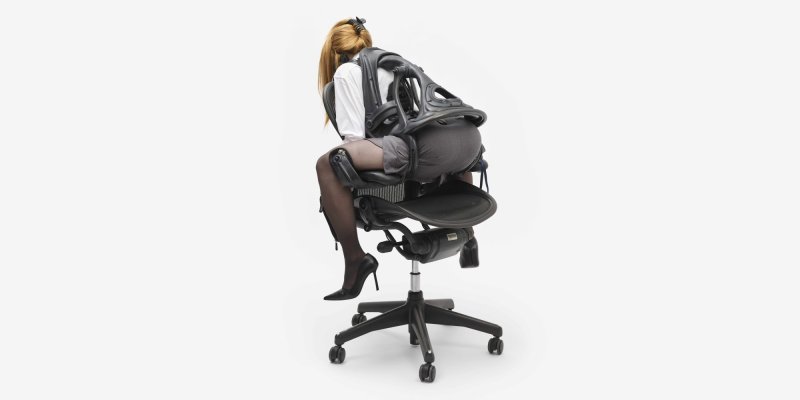
White Noise takes the enclosed architecture of the contemporary office space as an organizing structure, extending Anna Uddenberg’s ongoing interest in functionality as a means of control. Comprising her largest body of work to date, the exhibition becomes a Koolhaasian Junkspace: a compressed administrative interior of suspended ceilings, fluorescent light, partitions, ventilation systems, and Herman Miller office chairs. Uddenberg’s fragmented and increasingly disembodied figures lose their corporeal autonomy, becoming extensions of the furniture and systems that contain them; the body itself becomes part of the infrastructure.
The office in White Noise is deliberately generic. Gray wall-to-wall carpet, modular partitions, artificial light, and standardized furniture produce an environment without obvious geographical or temporal specificity, one that could be reproduced almost anywhere. A lowered ceiling compresses the gallery into a gridded administrative interior, altering the viewer’s physical relation to the space, while the absence of natural light makes the passage of time increasingly difficult to register. Above the ceiling, cables, ventilation, lighting, and technical systems normally kept out of view remain exposed. The environment is immediately recognizable, yet difficult to locate: familiar enough to require little conscious attention, but sufficiently displaced to produce a persistent sense of unease.
This contradiction is central to Uddenberg’s engagement with Rem Koolhaas’s concept of Junkspace: an architecture accumulated through systems intended to facilitate contemporary life, yet increasingly detached from the bodies inhabiting it. The exhibition’s psychological tension lies in the gap between an environment designed to accommodate the body and the conditions to which that body must nevertheless adapt. Sound requires management; exposure requires partitions; prolonged sitting requires ergonomic correction; the disappearance of natural time requires artificial illumination. Each accommodation seems to disclose another problem.
H-shaped panels divide the gallery into individual workstations without fully enclosing them, offering the appearance of privacy while preserving the visibility of the larger grid. Each figure occupies its own designated space but remains exposed to the environment surrounding it. Privacy becomes yet another spatial condition through which behaviour is organized.
Uddenberg’s figures appear suspended within these partitioned spaces, their bodies increasingly difficult to separate from the structures that support them. Reduced to torsos, or pairs of legs, fragmented anatomical forms are stretched across and folded into Herman Miller Aeron chairs, whose mesh surfaces and rigid frames contour the body while remaining almost transparent around it. Designed to adapt to the individual body, the Aeron appears here to produce the opposite relation.
Uddenberg’s office-like environment is structured by repetition, self-regulation, and the abstraction of labour. After moving to Berlin in 2015, Uddenberg worked in customer support for a car-sharing company, occupying what she has described as the position of a “human buffer” between the company and its customers. Calls were measured in time, actions registered through predetermined codes, and workers made responsible for tracking their own activity. This repetition eventually produced a peculiar temporal detachment in which one working day became difficult to distinguish from the next.
A new sound work extends the installation into the auditory field. Responding to the existing sounds of the building, its ambient frequencies—the hum of ventilation, electrical systems, and fluorescent lighting—are amplified and synthesized until the sound becomes almost indistinguishable from the infrastructure surrounding it. It has no obvious relation to an exterior world, belonging instead to an interior engineered to maintain its own continuous atmosphere. White noise occupies a peculiar threshold of perception: continuously present yet capable of receding from conscious awareness.
Administrative logic emerges in White Noise as a low-level, continuous form of aggression, dispersed throughout the environment rather than exercised by any singular authority. Nothing in the space appears overtly hostile. Its light, furniture, partitions, and sound all ostensibly exist to make the body more comfortable, productive, private, and autonomous. Yet every solution requires another adjustment, another support, another system through which the body must learn to move. Like the white noise itself, these conditions exert their pressure most effectively when they cease to be consciously perceived.
Text: Samuel Staples
Anna Uddenberg (*1982, Stockholm) lives and works between Berlin and Stockholm. Recent solo exhibitions include Premium Economy, TANK, Shanghai (2025) and Kunsthalle Mannheim (2023–24); Home Wreckers, The Perimeter, London (2023); Continental Breakfast, Meredith Rosen Gallery, New York (2023); and FAKE-ESTATE, Schinkel Pavillon, Berlin (2022–23). In 2024, she presented Premium Economy at Art Basel Unlimited. Uddenberg is the recipient of the Hector Kunstpreis (2022) and the Overbeck-Preis für bildende Kunst (2023). Her work has also been exhibited at institutions including the Centre Pompidou-Metz, Kiasma, Bundeskunsthalle, Moderna Museet, and Kunstmuseum Bonn.