Starting at 18:00
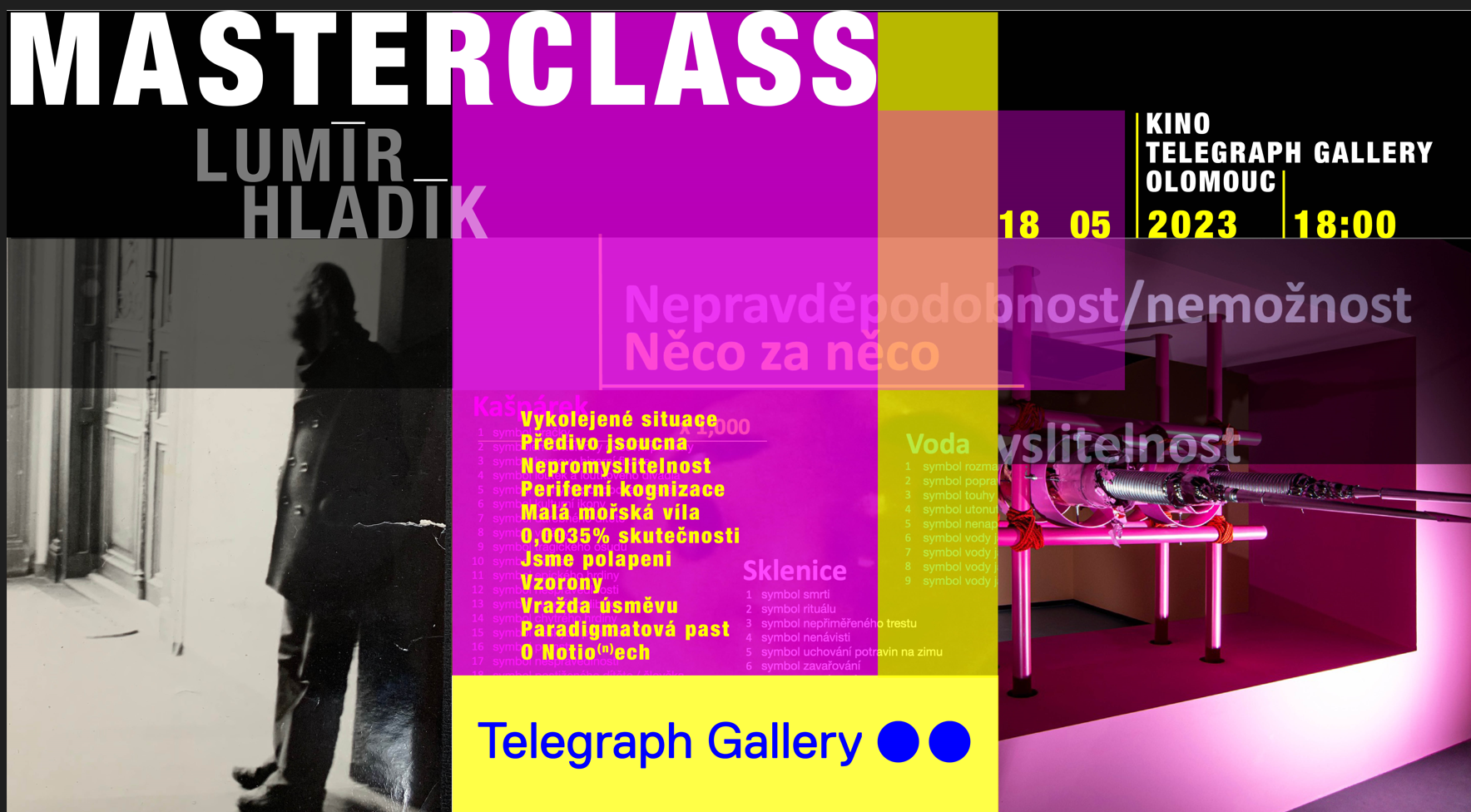
Hladík's MASTERCLASS was initiated by the National film archive of the Czech Republic (NFA). In 2019, the NFA acquired the artist's film documentation of his work from the 1970s for its collections. On the occasion of the premiere of these films at Prague's PONREP (2022), the archive asked the artist to give a lecture that would explain in more detail how these events were created, what they originated from and, above all, how they relate to the artist's current work. Since this is a time span of roughly 45 years, Hladik decided that a deeper analysis was needed, which he eventually developed into many related levels, and where he ended up dealing with cognition theory, art theory, and where he even found a close relationship between quantum physics and the role of art in the survival of human society. Here are a few key points from Hladik's Masterclass: How to Cut the Yarn of Existence. How to outsmart improbability. Undo/undo/unthinkability. What is the patterned passage. 10 trillion info-combinations in a work of art? Concept as anti/non/representational interpretation in a state of superposition. In March this year, Hladik's MASTERCLASS had another screening at the Dresdner Schmalfilmtage (Dresdner Schmalfilmtage) in Dresden.
Lumír Hladík is a post WWII neo-Avant-Garde artist, a pioneering figure of the 70s East European conceptual and performance art movement. Fascinated by its immediacy and formal freedom, he engaged in action art, installations and interventions, along with similar-minded artists such as Karel Miler, Petr Štembera, Jan Mlčoch and especially Jiří Kovanda. He has adopted a very distinctive form of body art, described by art historian Pavlína Morganová as arranging “derailed situations”, documenting his art in photography and 8mm film. His early work explored the notions of alterity, mortality and determinism.
Hladík's initial actions have mostly taken place outdoors, where he explored space and its manifestations, making visible through physical action what would otherwise remain invisible, or conversely, creating new invisibilities. Along a similar idea, Hladík conceptualized his second action, No one will disturb my circles! (1976), in which he ran around two large circles on a stubble field outside the city in the presence of a photographer. His aim was to run around circles large enough to impede the possibility of knowing if they intersected. In his work, Hladík is purposefully concerned with creating “not-knowledge”, which he considers a newly acquired experience. In a number of his action art pieces he thematizes man's relationship to existence and space, such as My Personal “Infinite” “Infinite” Vector (1977), Boundaries; a Question Without an Answer (1977), I Shrunk the Diameter of the Earth (1977), and The Disappearing Series, for which Jiří Kovanda assisted in the field near Český Brod.
In 1977, Hladík began to carry out actions in urban space, an example being I'm Not Finishing St. Vitus Cathedral (1977). The Prague cathedral, with its millennia of history and symbolism, called for a conceptual demonstration; Hladík touched one of the temple's pillars with the toe of his shoe and began to circle it. He didn't go around it completely, however; he stopped and measured the distance to the starting pillar with a tailor's tape measure - it was 14 cm. Prague was also the setting for Anonymous Door (1980) and Silence and Hunger (1980), both of which explore human solitude in the anonymity of the city.
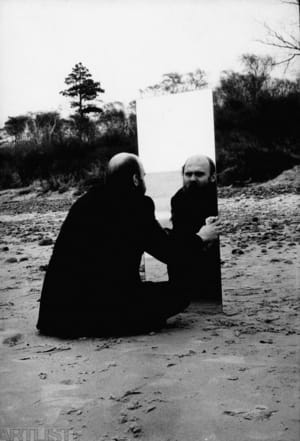
In the late 70s, a sense of exhaustion began to emerge in Prague’s body art circle, to which Lumír Hladík belonged. The very form of action art was changing: Petr Štembera ceased to carry out tense body art events, Jiří Kovanda replaced the events with unobtrusive installations in the framework of joint evenings. Lumír Hladík, however, created several major action art pieces in this period, which already reflected his potential emigration intent, and which eventually took place in 1981. In Somewhere, Nowhere (1979), Hladík was driven by a friend, blindfolded, in a car for several hours to an unknown location. After sitting him down onto a piece of grassland for a while, he drove him back again without ever revealing where they have been. The only action by Lumír Hladík, that was known in the Czech artscene until recently - The Sea in the Mirror (1980) - also dates from this period. Petr Rezek wrote about it in his cult book Body, Thing and Reality in Contemporary Art (published by the Jazz Section in 1982). Lumír Hladík asked his friends to drive him to the Baltic Sea; where they installed a mirror for him on the beach facing the sea, and led him blindfolded to it. It was only with his back to the sea when Hladík removed the blindfold from his eyes and observed its broad horizon in the mirror. Next, blindfolded again, he was led to his car and driven back to Bohemia. This radical action raises a whole range of questions and associations, reflecting an existential desire for freedom, but also the seeming impossibility of achieving it in totalitarian Czechoslovakia. There is a film footage of the action, which is unique in the Czech action art of the 1970s. Hladík's very last action before his emigration to Canada is Nowhere (1981), which was also an attempt to touch the imaginary border between reality and its illusionary appearance.
After moving to Canada in 1982, the artist spent over three decades studying natural entropy in the Canadian wilderness. His art, an eclectic mix of gothic majesty, baroque exuberance, retro-curia and sleek urban glitz-kitsch exploits a wide spectrum of disciplines such as drawings, mixed media, vintage ready-mades, performance art, video, sound and photography. Hladík’s bio-interventions, an inter-species collaborative work that incorporates destructive marks of wild black bears and other Canadian wildlife, are exploring notions of historical and cultural amnesia.
By the means of cross-pollination of a wide range of contentious themes; quantum physics, biology, pop culture, history, philosophy or religion, Hladík is synthesizing a frenzied alchemy of multilayered innuendos, riddled with ambiguity and myriads of subtle references. He claims that his art responds to today’s society’s ubiquitously ridiculous “rational” defence of its own irrationality. His art has been acquired by prominent art institutions: such as the National Gallery in Prague, National Gallery of Canada, The Tichy Ocean Foundation Collection in Zurich, the National Film Archive of the Czech Republic, GMU Hradec Králové, GAVU Cheb, GASK Kutná Hora and many others.